

Dear reader,
It has been a rough couple of years for UK housebuilders. Mortgage rates have stayed higher for longer than buyers hoped, and the conflict in the Middle East knocked confidence further this spring. The summer selling season, when builders usually make up lost ground, brought little relief.
- Dan Coatsworth, head of markets at AJ Bell
Westminster hasn’t made life simpler. Labour came to power promising 1.5 million new homes this parliament, and the housing secretary has since admitted there is only a slim chance of hitting that target. The summer also brought a change of prime minister. Andy Burnham entered Number 10 in July pledging more council homes, with Angela Rayner returning as housing secretary. The emphasis has shifted firmly towards social and affordable housing, delivered largely through housing associations and councils.
On paper, that should suit Vistry Group (LON:VTY) better than anyone. It has turned itself into the country’s biggest partnerships housebuilder, building for housing associations, councils and rental investors alongside private buyers. It was also named a strategic partner under the government’s new affordable housing programme and won the largest direct grant in the first wave. Even so, it has had a miserable year on the stock market, and the shares fell again on results day.
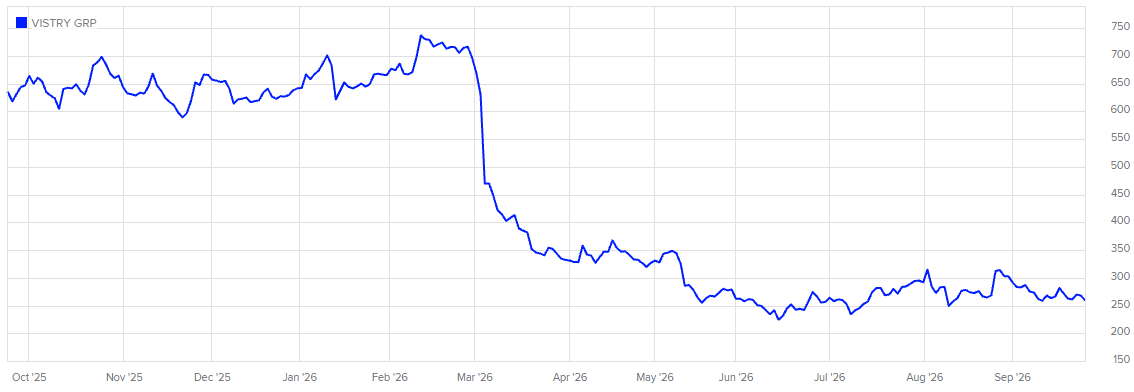
Thursday’s half-year results came alongside a review of the business by Adam Daniels, chief executive since April. Taken together, they amount to an admission that the partnerships model grew faster than the company’s controls could keep up with. This piece works through what Vistry reported and what the reset means for the business.
In short
A deep adjusted loss, and a far bigger reported one once a £475m goodwill write-down is included
Net debt up sharply, and the year-end cash target cut to broadly neutral
A plan to shrink to around 12,000 homes a year
Lenders have waived a key loan test to give the plan room to work
Reading the accounts
Vistry reports two sets of figures. The adjusted numbers include its share of joint ventures (sites developed with partners, with profits split) and strip out items treated as one-off. The reported numbers follow standard accounting rules and include everything. Adjusted shows how the business traded, while reported shows what happened to shareholders’ equity. This half, the gap between them is enormous.
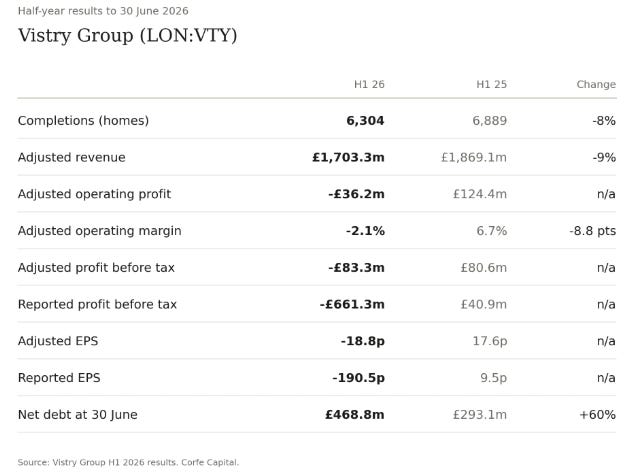
Completions fell 8%, but the two sides of the business moved in opposite directions.
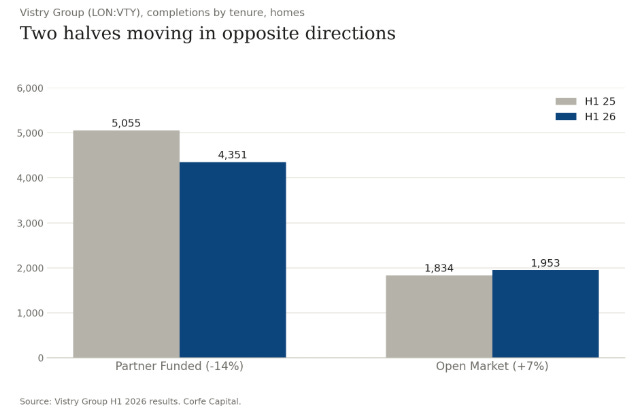
Partner Funded completions, meaning homes sold to housing associations, councils and rental investors, dropped as partners held back waiting for grant allocations under the new government funding programme. Those allocations were only confirmed in the third quarter, so the dip should prove temporary. Private sales rose, but only because Vistry cut prices to clear stock, and the average private selling price fell 2% as a result. Adjusted revenue fell 9% to £1,703.3m.
The fall into an adjusted operating loss of £36.2m, from a £124.4m profit, is the part worth dwelling on, and Vistry is fairly open about where the money went.
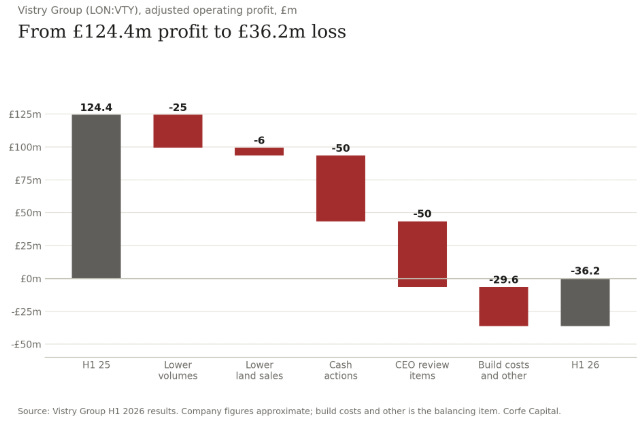
Lower volumes and land sales played a part, but the two biggest bars were self-inflicted. Around £50m went on discounting homes, slowing build on some sites and doing deals that brought cash in sooner at the expense of profit. A similar amount came from the first costs of the CEO review, mostly writing down sites that no longer fit the plan. Vistry doesn’t put a figure on the rest, which it attributes to build cost inflation and the cost of keeping sites open longer as sales slowed. After interest costs of £47.1m, up 8% on higher borrowing, the adjusted pre-tax loss was £83.3m.
That makes this half a poor guide to what the business can earn. Roughly £100m came from deliberate actions to raise cash and reset the business, rather than the ordinary cost of building homes. The trouble is that it also makes the underlying picture hard to judge. A clean read on what the smaller business can earn probably won’t come until the 2027 results, once this year’s restructuring charges have passed through.
The reported loss of £661.3m adds two big items. The first is a £475m write-down of goodwill, an accounting asset created when Vistry bought businesses over the past six years for more than the fair value of their assets. The charge is non-cash, but it reflects a company that now expects to be much smaller than those deals assumed. The second is a £73.2m addition to the fund set aside for fire safety repairs, driven mainly by a wave of claims on buildings where Vistry acted as contractor. The company doesn’t expect claims at that level to recur.
On the balance sheet, goodwill has fallen to £352.6m and net assets are down 18%. The more telling number is capital employed, which on Vistry’s measure covers land, homes under construction and joint ventures, less what it owes landowners and suppliers. It rose 10% to £2.84bn. For a model sold as capital-light, that’s the wrong direction.
Cash and debt
Net debt rose from £144.2m in December to £468.8m at the end of June. A housebuilder’s borrowing rises and falls through the year, so a single date can miss the full picture. Average daily net debt gives a truer measure, and it was £799m across the half, up from £695m a year earlier.
Where the cash went
Trading loss: £83.3m
Paying landowners and suppliers faster: £153.4m, most of it clearing land creditors (money owed on land bought on deferred terms)
Joint ventures: £31.3m lent to help them clear their own debts
Fire safety repairs: £27.1m
Tax and share buybacks: £29.6m, with buybacks paused in May
Clearing old bills early is sensible housekeeping, but it landed in the same half as the trading loss, and the two compounded each other.
The fightback
Unsold homes: stock under construction without a buyer halved from around £600m to under £300m, with another £80m or so cleared since June
Part exchange: largely sold in July for £20m, and Vistry will no longer take buyers’ old homes as part payment
Land buying: cut back from the second quarter
Most of that cash lands in the second half, but it hasn’t been enough to hold the year-end target. In its July trading update, Vistry was still forecasting more than £100m of net cash by December. It now expects a broadly neutral position, citing weak summer sales and partner deals it has walked away from or is renegotiating. Even the neutral figure depends on two large partner transactions, worth around £173m of net cash, completing before the year end.
The lenders
Vistry’s loans come with covenants, conditions it must meet to keep borrowing. One is interest cover, a test that profits comfortably exceed interest costs. With the reset charges landing this year, Vistry expects to fail it at the next two checkpoints, and its banks have agreed to waive the test for December 2026 and June 2027. In return, Vistry must hold at least £70m of spare cash and facilities at each month end. A downside scenario in the accounts, combining weak sales, cancelled deals and rising costs all at once, shows Vistry outgrowing its facilities by August 2027 before any action by management. The directors stress that scenario is unlikely, but it shows how little slack there is.
For its part, the company says that following the actions taken, it does “not anticipate any need to raise equity.”
The targets
The longer-term aim is a much lighter balance sheet, measured on the average daily figure.
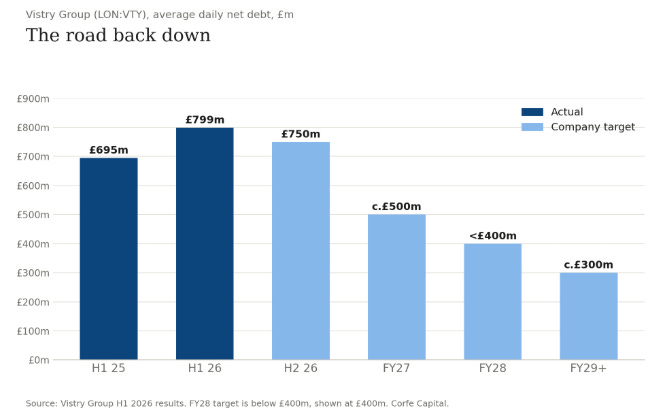
Shareholder payouts won’t be reconsidered until meaningful progress has been made on all of this.
The reset
"Our execution, regional discipline and capital allocation have not been consistent enough."
-Adam Daniels, Chief Executive
The review’s conclusion is simple enough. The partnerships model is right, but Vistry grew faster than its controls could handle. The fix is a smaller, tighter business, with a roughly 60:40 split between partner-funded homes and private sales, and an end to private sales in the South East.
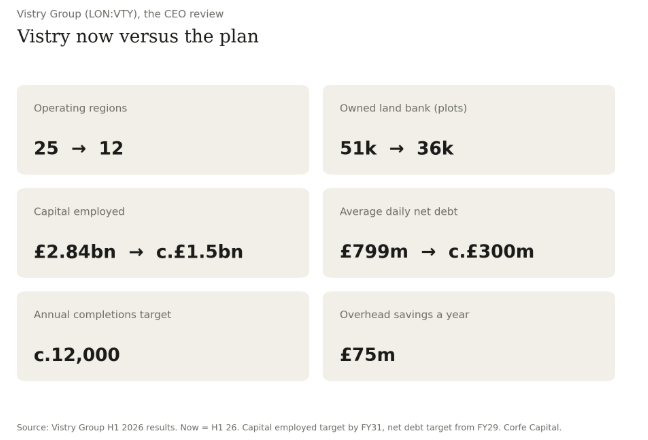
The most encouraging detail is buried in the review. Around 60% of the business already works well, with high returns and an 18.5% gross margin. If Vistry can bring the rest up to that standard, the plan has a solid foundation.
The reset isn’t cheap. Around £470m of further charges are flagged for the second half, mostly from writing down South East sites and land that no longer fits. Before those charges, Vistry expects adjusted pre-tax profit of around £165m this year and about £185m in 2027. On the results call, the CFO put the first-half loss at around £30m before review items. Hitting £165m therefore needs a second half of roughly £195m, which is a very heavy reliance on the next six months. The longer-term goal is a 12% operating margin and returns on capital above 30% by 2031.
Verdict
The numbers are poor, though the review is unusually frank about how the business got here. Vistry has also tightened its order book to count only legally exchanged contracts, which now stand at £3.3bn, with 91% of this year’s expected sales secured. Management appears to be choosing conservative measures over flattering ones, which should make future updates easier to trust.
Against that, the guidance has moved twice in three months. A July profit warning was followed by this week’s cut to the year-end cash target, and the new target still leans on two large deals completing before December. Those two deals are the first real test of whether the revised numbers can be relied on.
The bull case
Government money is flowing again, and Vistry holds the largest direct grant in the first wave
60% of the business already delivers high returns, which suggests the model works when run properly
The partner lull looks temporary, and the second half should be stronger
The banks are supportive, and management does not expect to need to raise equity
The bear case
The model still relies on private sales, and the private sales rate slowed to 0.3 reservations per sales outlet per week over the summer, from 0.49 across the first half
Year-end cash depends on two specific deals completing on time
The covenant waiver buys time rather than solving the problem, and the downside scenario leaves little margin
The key targets sit five years out, with a new finance director yet to be named
The full-year profit guide depends on a second half far stronger than the first
"We are committed to entering 2027 on the right footing."
-Adam Daniels, Chief Executive
What to watch
Whether the two large partner deals complete before December
The new CFO appointment, expected imminently
Deal flow under the new affordable housing programme in the fourth quarter
Trading updates ahead of full-year results in March 2027
Vistry has chosen to take its pain now, in one large dose, and the plan is coherent. Whether it works depends on two things outside the review’s control: a private market that stops getting worse, and partners who turn government funding into signed deals. The next two trading updates should show whether either is happening.
Ollz.
Further reading

25 August 2026. How Vistry’s £350m Homes England award revived partner demand, and why the business still had to prove it could turn government funding into profitable growth. These results are the first real test of that.
References
Vistry Group PLC, Half year results for the period ended 30 June 2026, 24 September 2026
Vistry Group PLC, Trading update, 8 July 2026
Yahoo Finance, Vistry Group H1 earnings call highlights, 24 September 2026
LBC, Vistry shares plunge on warning over first-half losses, 8 July 2026
Mortgage Solutions, Government unlikely to meet 1.5 million new homes target, 14 September 2026
Architects’ Journal, Burnham pledges council homes drive as Rayner returns, 21 July 2026
This article is for information and educational purposes only. It is not investment advice or a recommendation to buy or sell any shares or other investments, and it does not take into account your personal circumstances.
It's really not what you wanted from Vistry. Their model is supposed to be largely acylical and robust. But they've shows consistently that they have awful internal controls, poor acquisition integration and a lack of discipline.
I was a shareholder for quite a bit but reserve special credit for their ingenuity, I can't think of any company that has discovered so many different ways to drop the ball.