

Dear reader,
Andy Burnham spent part of this week in New York, and while he was there he sounded like a Prime Minister trying to talk down tax rises. He said Labour had already delivered two budgets, in 2024 and 2025, and had to be mindful of how much revenue it had already raised. Back home, the figures pointed the other way. On Tuesday the ONS reported that the government borrowed £18.3bn in August, £3.5bn more than planned. That takes borrowing for April to August to £8bn over budget.
That leaves John Healey in a tight spot. Earlier this month, Bloomberg Economics estimated that the sell-off in gilts would wipe roughly £12bn off his £23.6bn buffer, about half of it gone before he has delivered a single Budget. The Prime Minister is signalling caution on tax, but the borrowing figures suggest he may not get the choice.
The UN week: talks on the sidelines, oil on the move
The UN General Assembly is usually background noise for markets. This year it wasn’t. Donald Trump and Iran’s President Pezeshkian both gave defiant speeches while their negotiators held talks on the sidelines. Trump said he faced a big decision between cutting a deal and wiping out the Islamic Republic. Pezeshkian told the room Iran would not surrender.
Oil reacted to every headline. The week started with some relief when Saudi Arabia restarted its East-West pipeline on Tuesday. On Thursday, Iran-aligned Houthi fighters in Yemen fired missiles at Saudi Arabia and Brent jumped about 5% to $108.23 at its peak. Later that day, Iran’s foreign minister said Tehran had sent Washington a seven-day plan to reopen the Strait of Hormuz, on condition that the US lifts its naval blockade and unfreezes Iranian assets. On Friday, reports that the two sides were weighing a phased deal pulled Brent back to around $105.70. It still finished the week up more than 2%. Xi Jinping was in Washington at the same time, and Iran was on the agenda there too.
For London that meant a stop-start week for the oil majors. BP and Shell were among Thursday’s best performers, then BP gave it back on Friday. Energean fell 10% over the week even as the barrel rose, which I come back to in the fallers. The precious metals miners swung with gold and silver, which fell sharply early in the week and then recovered on Friday.
Westminster: the Budget comes into focus
Labour’s conference opens in Liverpool on Sunday. Burnham will get his standing ovation, but the market is waiting for 28 October, not for the speech. The manifesto rules out rises in VAT, income tax, employee National Insurance and corporation tax, which shifts attention to the taxes that are left. The Treasury is reportedly looking at raising capital gains tax to 45% and cutting the mansion tax threshold from £2m to £1.5m. That is only a report, not policy, but it is the kind of headline that makes investors think twice about wealth managers and anything tied to high-end property.
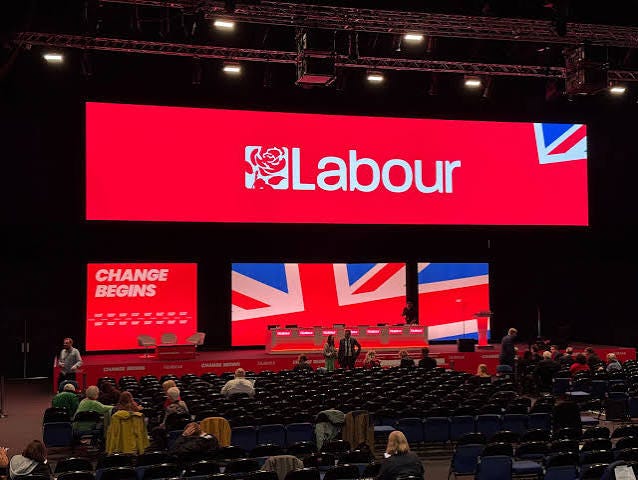
So the messages are mixed. The Prime Minister is talking down tax rises, the borrowing figures are pointing towards them, and the bond market will decide which one wins.
The index barely moved, but the mid-caps told a clearer story
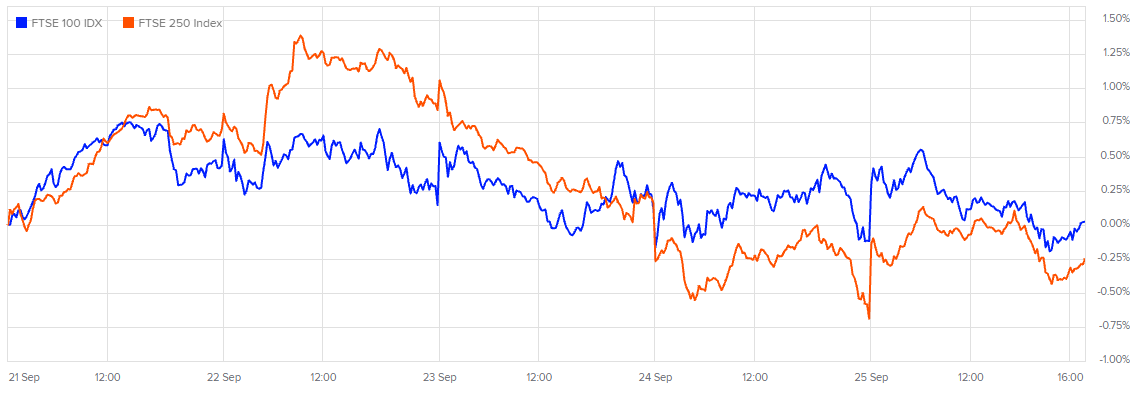
London didn’t do much again. The FTSE 100 finished Friday at 10,695.25, up 0.3% on the week, with the FTSE 250 up 0.2%. That makes two quiet weeks running, and once again the action was underneath the headline number. This time it had a clear shape. Results season was in full swing, and the companies that showed real numbers mostly got paid for them. I’ll come back to that at the bottom.
The movers
A scan of the week, with a verdict on each. Signal means the story genuinely changed. Noise means a move to look past.
Risers, FTSE 100
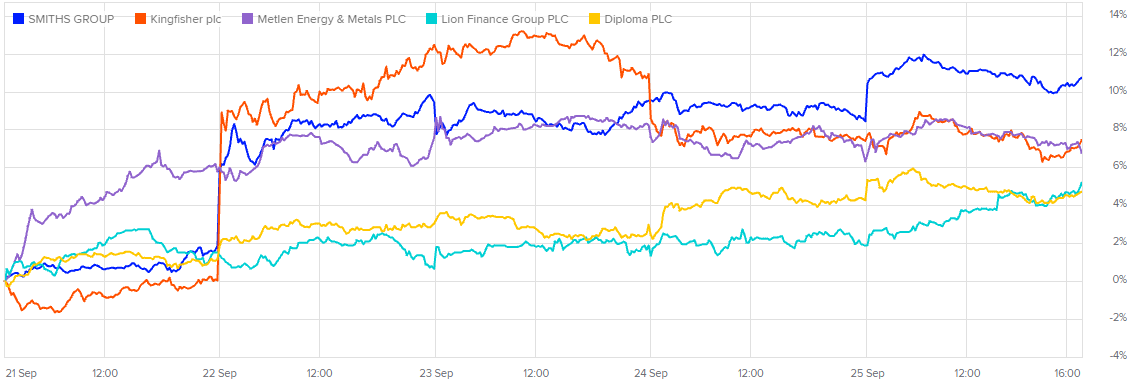
Smiths Group (LON:SMIN), +11.00% to 2,816.00p, posted the cleanest result of the week. The shares jumped 6% on Tuesday after full-year numbers came in slightly ahead of expectations. The trading figures themselves were modest, but the reshaping was not. Selling its Detection and Interconnect businesses for £3.3bn turned net debt into £1,747m of net cash. Management guided to around 4% organic growth, well above the 1.2% the remaining business managed this year. A 175-year-old engineer slimmed down to two divisions with a pile of cash is what the activists asked for, and the market now has it. Signal.
Kingfisher (LON:KGF), +8.81% to 328.40p, is on the riser board for the second week running, and this time it earned the place. Last week I called it a rotation bounce. This week the half-year numbers did the work. Profit attributable to shareholders rose 22.6% to £290m, about 6% ahead of consensus, and full-year profit guidance went up to £595m to £635m. There are asterisks. A £14m business rates refund helped, and B&Q is still being carried by Screwfix. But a DIY retailer upgrading guidance ahead of a tax-raising Budget doesn’t happen often. Signal.
Metlen (LON:MTLN), +8.64% to €48.04, has made a round trip. It fell 7.06% to €44.24 last week in the energy-and-metals slide and bounced straight back this week. I couldn’t find a hard catalyst either way, so read it alongside the miners. Noise.
Lion Finance Group (LON:BGEO), +6.42% to 14,580.00p, the owner of Bank of Georgia, closed the week at a fresh 52-week high. There was no big news, just a high-returning bank in Georgia and Armenia extending a run that has left the wider market well behind over six months. Momentum.
Diploma (LON:DPLM), +5.74% to 7,740.00p, touched a new 52-week high of 7,775p on Thursday, though on much lighter trading than usual. A steady compounder drifting back to its highs in a week that rewarded delivery. Momentum.
Fallers, FTSE 100
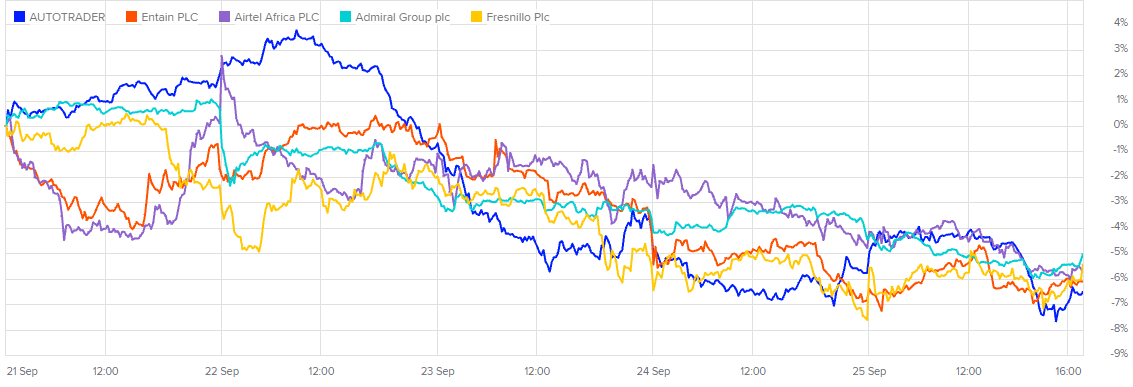
Auto Trader (LON:AUTO), -6.51% to 456.40p, was caught in the classifieds sell-off. The full story is in the FTSE 250 section, where the damage was heavier. Signal, as part of that trade.
Entain (LON:ENT), -5.66% to 449.70p, comes with a housekeeping note. The data sources still list it with the blue chips, but Entain left the FTSE 100 at the close on 18 September and joined the FTSE 250 on the 21st. No fresh news pushed it lower. The UK tax hit is already in the numbers, and a Budget that looks set to raise taxes is an awkward thing to hold a bookmaker through. Macro.
Airtel Africa (LON:AAF), -5.31% to 299.60p, is last week’s story still running. The shares fell 11.3% last Friday after a report that Airtel Money might downsize its London IPO. This week the float was reset to a lower valuation and a smaller share sale. It is a secondary sale, so existing holders sell and the business itself raises no new money. Signal, second week running.
Admiral (LON:ADM), -5.24% to 3,618.00p, slid without a company-specific trigger I could find. Motor insurers have been treading water all year while premiums catch up with repair costs. Noise.
Fresnillo (LON:FRES), -4.78% to 2,890.00p, is the precious metals unwind again. Gold and silver dropped sharply early in the week before recovering on Friday, and a miner this geared to silver takes the full swing both ways. Macro.
Risers, FTSE 250
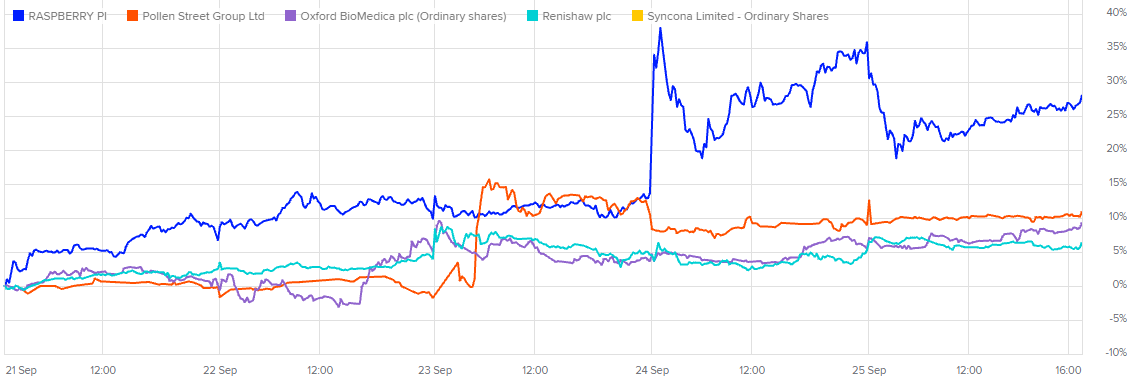
Raspberry Pi (LON:RPI), +30.07% to 711.50p, was the biggest move on either index. First-half revenue rose 90% to $256.9m, and adjusted EBITDA rose 108% to $40.3m. EBITDA is a rough measure of operating profit before interest, tax and the cost of wearing out equipment. The reason behind the jump matters. Raspberry Pi stockpiled memory chips in 2025, before prices spiked, and this year it sold boards built with them at much higher prices. Management says that cheap inventory has now largely been used up, and gross margin has already slipped two points to 23%. So this was a record half with a one-off inside it. Signal, with a caveat.
Pollen Street Group (LON:POLN), +11.38% to 920.00p, is bid speculation made official. After a Reuters report, the private equity and private credit manager confirmed it is exploring options, including a take-private, and has begun early talks with a small number of parties. A take-private means a buyer acquires the whole company and removes it from the stock market. Pollen Street runs £8.4bn of assets, and a mid-sized listed fund manager looking for a buyer is becoming a familiar London story. Signal.
Oxford Biomedica (LON:OXB), +10.82% to 507.00p, rose with no fresh catalyst I could pin down. The shares had been sitting at about half their 52-week high, and at that level a sharp bounce doesn’t need much of a reason. Noise.
Renishaw (LON:RSW), +9.37% to 5,660.00p, delivered record full-year results. Revenue rose 14% to £815.8m on demand from semiconductor, aerospace and defence customers, and adjusted earnings per share rose 30% to 179.5p, ahead of forecasts. The board added a special dividend, a one-off payment on top of the regular one. The shares had already run to a 52-week high before the numbers, and the results justified the run. Signal.
Syncona (LON:SYNC), +9.32% to 122.00p, had the biotech win of the week. Its portfolio company Beacon Therapeutics said a late-stage trial of its gene therapy for a rare inherited eye disease met its primary endpoint, the main goal the trial was designed to test. Syncona owns 38.4% of Beacon, a stake valued at £183.4m at the end of June, before the result. The next net asset value update will show what that stake is worth now. Signal.
Fallers, FTSE 250
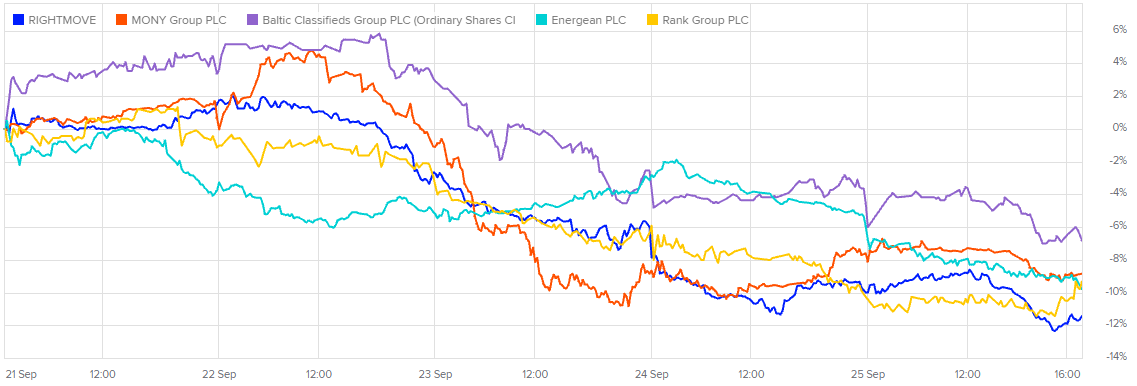
Rightmove (LON:RMV), -9.82% to 440.90p, Mony Group (LON:MONY), -8.32% to 177.30p, and Baltic Classifieds Group (LON:BCG), -7.66% to €2.05, fell together, alongside Auto Trader. The online marketplaces sold off on worries about AI disruption. The fear is that AI agents could one day search and buy on a customer’s behalf without ever visiting the portal. Rightmove took most of its hit on Thursday, dropping over 5% to 441p intraday. I owe you a correction on Baltic Classifieds. Last week I called its 9% fall noise. Two weeks and about 16% later, it clearly isn’t. Signal.
Energean (LON:ENOG), -10.53% to 718.00p, was the worst performer in the index. It also fell in a week when Brent rose more than 2%, which makes it the odd one out among the energy names. There was no company announcement, so the most likely explanation is geography. Energean’s main gas fields sit off Israel, and they have been shut twice in the past eighteen months, including 41 days this spring. In a week when an Iranian military official threatened to widen the war, a producer that close to the front line was a harder sell. That is context rather than a confirmed cause. Noise, with a regional risk premium attached.
Rank Group (LON:RNK), -8.92% to 76.60p, is still living under the Budget cloud. Its recent annual report flagged possible closures at three Grosvenor casinos and repeated its warning on the tax charged on gaming machines. With tax rises looking more likely by the week, nobody is in a hurry to own a casino operator. Macro.
Idea of the week: price the receipts, discount the story
Line up the week and the pattern is hard to miss. Smiths, Kingfisher, Renishaw, Raspberry Pi and Syncona all rose on things that actually happened: a set of accounts, a guidance upgrade, a trial result. The classifieds fell on something that hasn’t happened yet. None of Rightmove, Auto Trader, Mony or Baltic Classifieds reported bad numbers this week. They were sold on a scenario.
I wrote up Rightmove in July, when the shares were 438p, against the 775p REA Group offered in 2024 and the board turned down. This week they closed at 440.90p. The price has barely moved since July, but the argument around it has hardened. The market is treating the AI threat to the portals as close to settled, while the companies’ own numbers still don’t show it.
The same filter cuts the other way. Raspberry Pi’s record half leaned on a memory stockpile that won’t be repeated, and Kingfisher’s beat included a rates refund. Receipts can flatter too.
It’s 33 sleeps until the Budget, and with the borrowing figures working against the Prime Minister’s caution on tax, the market is likely to stay picky about what it pays for. Companies that can show the numbers will keep getting the benefit of the doubt, and stories with nothing in the accounts yet will keep being priced as if the worst case is already here. The classifieds are where that gets tested. Their next set of numbers will show whether the traffic has actually gone anywhere.
Thanks for reading,
Ollz.
This article is for informational and educational purposes only and does not constitute financial advice. The author may hold positions in securities mentioned. Always do your own research and seek independent financial advice before making any investment decision. Capital is at risk.
Sources
[1] ICAEW: August public finances, https://www.icaew.com/insights/viewpoints-on-the-news/2026/sep-2026/budget-overrun-widens-as-public-finances-disappoint
[2] PA via Yahoo Finance: FTSE weekly close, https://uk.finance.yahoo.com/news/ftse-100-edges-oil-fall-162219549.html
[3] CNBC: UN speeches and Brent’s Thursday spike, https://www.cnbc.com/2026/09/24/oil-iran-crude-kepler-trump-us-un-.html
[4] Oil & Gas Middle East: Brent on Friday and the weekly gain, https://www.oilandgasmiddleeast.com/news/brent-crude-falls-below-106-as-us-and-iran-weigh-phased-hormuz-deal
[5] Hyphen: Burnham in New York, the buffer and Labour conference, https://hyphenonline.com/2026/09/25/andy-burnham-labour-conference-2026-budget-john-healey/
[6] Proactive Investors: Smiths Group, https://www.proactiveinvestors.co.uk/a/4d58bb7f/smiths-shares-rise-6-as-brokers-back-reshaped-engineer
[7] AskTraders: Raspberry Pi, https://www.asktraders.com/analysis/raspberry-pi-shares-surge-as-profit-triples-on-cheap-memory-but-windfall-fades/
[8] Kalkine Media: classifieds sell-off, https://kalkinemedia.com/uk/stocks/bluechip/auto-trader-auto-slips-as-ai-agents-spook-marketplaces-this-week-is-the-car-portals-moat-under-threat