

Dear reader,
This was the week the gilt market stopped waiting for the Budget. On Thursday the yield on the 30-year gilt touched 6% for the first time since 1998, before easing to about 5.9% by the close. The yield is the annual return the government has to offer to borrow for that long, so a higher number means dearer borrowing. The 10-year yield had already hit 5.44% on Monday, its highest in 19 years.
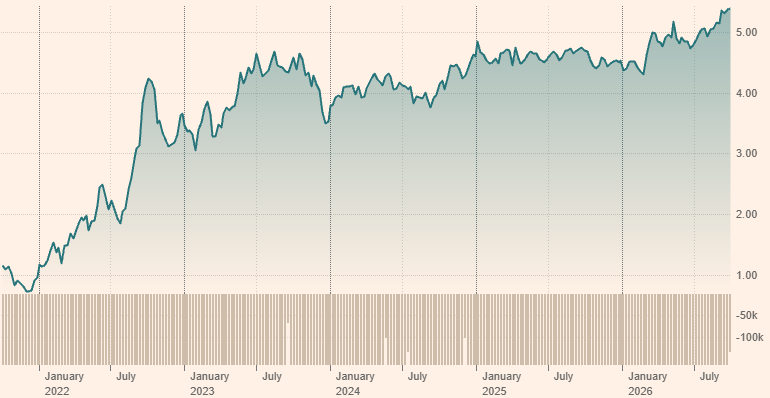
The warning came earlier in the week. On Tuesday the Debt Management Office sold £4.25bn of 10-year gilts at an average yield of 5.38%, the highest for a sale of that length since 1999. Strong American data on Thursday afternoon made it worse. The prices measure in the US manufacturing survey jumped to 77.9 from 71.1, and the US 10-year yield touched 5.34%. Gilts have been moving with US government bonds, so London took the hit too.
The FTSE 100 fell 1.68% on Thursday to 10,428.27, its worst day since May. Banks, housebuilders and domestic names led it down.
Liverpool: a housing scheme and a fiscal promise
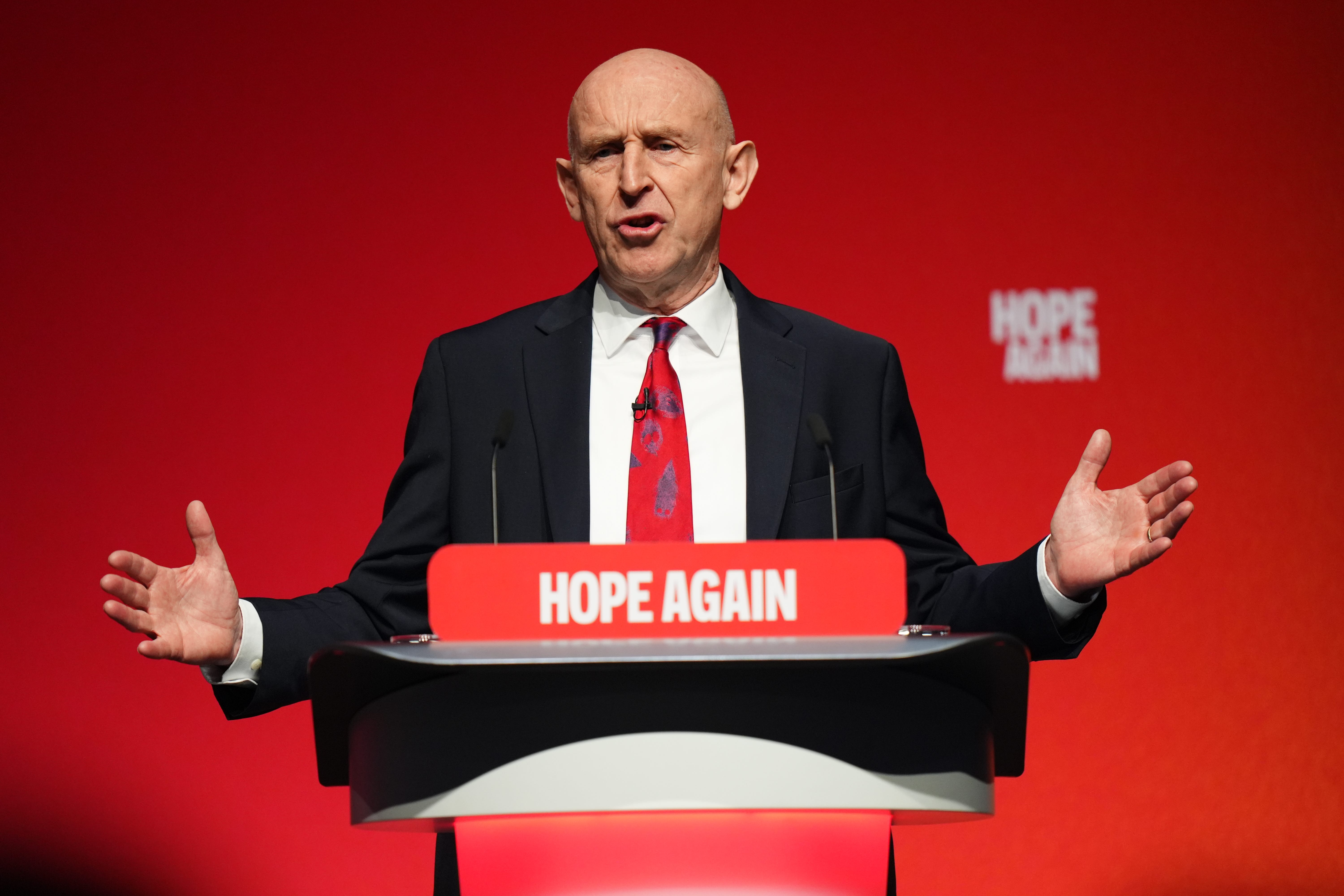
Burnham opened conference week with a gift to the housebuilders. Over the weekend he announced Your First Home, which broker Panmure Liberum called the younger sibling of Help to Buy. First-time buyers in England with a 2.5% deposit would get a loan worth 20% of a new-build home’s value, interest-free at first, with caps on household income and local prices. The details come in the Budget. On Monday the sector had one of its best days on record, with Barratt Redrow up 14.4%, Persimmon up 14.6% and Vistry up 12.3%.
John Healey spoke to the conference on Monday. He told the hall that he and the Prime Minister are in lockstep on meeting the fiscal rules, the limits the government sets on its own borrowing. “There is nothing progressive about losing control,” he said.
Andy Burnham’s speech on Tuesday pointed somewhere more expensive. He promised stronger public control of energy, water and housing, and a National Care Service with no care charges. He also confirmed that VAT would come off electricity bills on Thursday. Gilts held steady after the speech, helped by another commitment to the fiscal rules. Berenberg’s Andrew Wishart argued the plan can’t be delivered while keeping the 2024 promise not to raise personal tax rates.
Two days later the 30-year yield touched 6%. Inflation was 3.1% in August, and earlier this month Bloomberg Economics and last month Bloomberg Economics reckoned half of Healey’s £23.6bn buffer had already gone. It’s 26 sleeps until 28 October.
Oil: Trump says no
Iran’s seven-day plan didn’t survive the weekend. Donald Trump rejected Tehran's offer to reopen the Strait of Hormuz within a week in return for frozen funds, sanctions relief and an end to the US naval blockade. Brent rose more than 3% in Asian trading on Monday to nearly $108. Iran’s delegation in New York then said it had no plans to negotiate with the US there, though mediators are still working on a deal.
Ships are moving, slowly. MarineTraffic counted 132 transits of the strait in the week to 27 September, up from 116 the week before. Brent finished the week a little above $100. Part of the drop from last Friday’s $105.70 is the market moving on to the December contract, which trades cheaper, so I wouldn’t read much into the weekly change. BP was one of the few blue chips to rise on Thursday. The precious metals miners had a harder week, which I come back to in the fallers.
The index
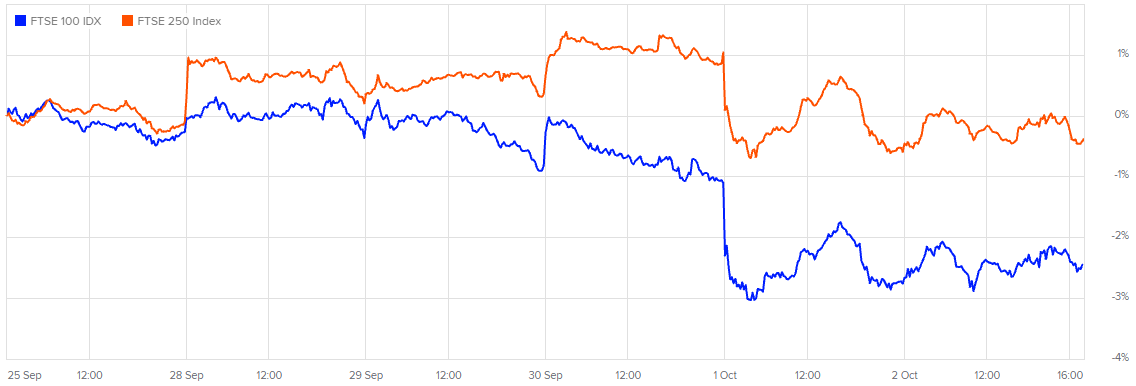
The FTSE 100 finished Friday at 10,461.95, down 2.18% on the week. The FTSE 250 got off far more lightly, down just 0.28% to 24,194.24. Thursday did most of the damage to the blue chips, with banks and housebuilders leading the selling. After two quiet weeks the market finally had a theme. Shares tied to borrowing costs went down, and the names that rose mostly had their own news, usually a bid or a set of numbers. I’ll come back to that at the bottom.
The movers
A scan of the week, with a verdict on each. Signal means the story genuinely changed. Noise means a move to look past.
Whitbread (LON:WTB), +3.92% to 2,440.00p, rose without a fresh announcement. The backdrop is the activist. Corvex, which owns about 6.4% of the Premier Inn owner, asked the board on 22 September to call a shareholder meeting to vote its partner James Gemmel on to the board. It has dropped its earlier demand for a sale and says it isn’t seeking control. The board still has to decide whether to call the meeting. Noise, with an activist in the background.
Convatec (LON:CTEC), +3.44% to 216.60p, had no news this week. The medical products group sells chronic care products such as ostomy bags and catheters, and most of its revenue comes from outside the UK. In a week when domestic names sold off, that made it somewhere to hide. Its next trading update is on 18 November. Rotation.
Halma (LON:HLMA), +3.33% to 3,600.00p, made up ground this week after last week’s trading update. On 24 September the safety and health technology group raised its profit margin guidance for the year to March 2027 to between 23.5% and 24%, against 22.7% last year. It also kept its forecast of low double-digit organic growth, meaning growth from the businesses it already owns, leaving out acquisitions. The shares are still well short of where they stood before June, when slower growth guidance knocked nearly 15% off in a day. Half-year results are due on 19 November. Signal.
Barratt Redrow (LON:BTRW), +2.98% to 318.20p, had a wild week and ended with a small gain. It jumped 14.4% to 353.35p on Monday after the Your First Home announcement, then gave most of it back as gilt yields and swap rates rose. Swap rates are the market rates lenders use to price fixed-rate mortgages, so they feed straight into what buyers pay. The scheme supports demand while dearer mortgages work against it, and by Friday the market was weighing the two almost equally. Panmure Liberum also warned the scheme would take a couple of years to work, and nobody yet knows how much housebuilders will have to contribute to take part. Signal, with Macro pulling the other way.
InterContinental Hotels Group (LON:IHG), +2.88% to $160.85, is priced in dollars in London and earns most of its money outside the UK. In a week when the problem was British borrowing costs, that was enough. No company news. Rotation.
Fallers, FTSE 100
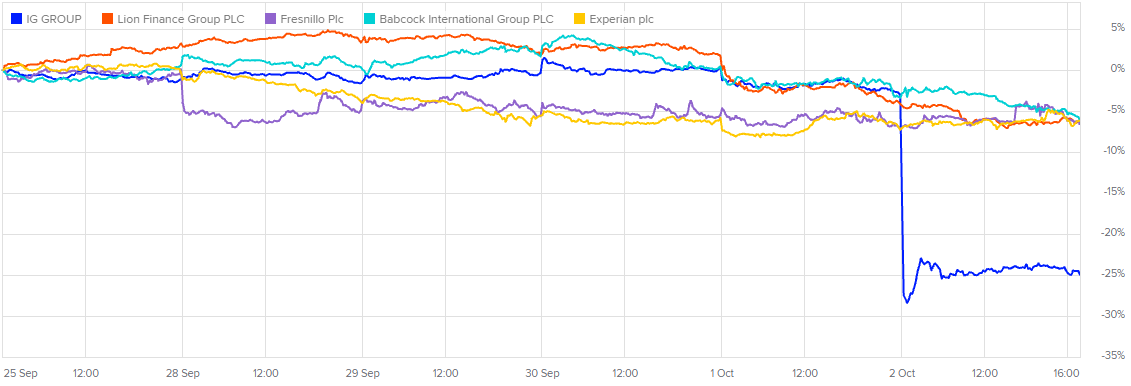
IG Group (LON:IGG), -24.14% to 990.00p, had its worst day in almost a decade on Friday. The online trading platform said third-quarter revenue will be about £240m, down 14% on a year ago, and cut its 2026 growth forecast to the mid-single digits. Peel Hunt pointed out that previous guidance was 10% to 15%, and the market expected about 12%. Margin guidance came down too. IG now expects an EBITDA margin in the low 40s against a consensus of 45.5%. EBITDA is operating profit before interest, tax and the cost of wearing out equipment, and the margin is that profit as a share of revenue. Peel Hunt thinks consensus profit forecasts could fall by a high-teens percentage.
The cause was weaker revenue retention. That is the share of clients’ trading that ends up as revenue for IG, and it falls when clients’ bets go their way. The customer numbers were good, with active customers up about 17% and first trades up more than 25%. A strategy update follows on 22 October. Signal.
Lion Finance Group (LON:BGEO), -9.05% to 13,260.00p, gave back more than last week’s gain. Last week I tagged it Momentum after a fresh 52-week high. This week the owner of Bank of Georgia was among Thursday’s biggest fallers as bank shares sold off with gilts. There was no company news, and its banks operate in Georgia and Armenia rather than the UK. Macro.
Fresnillo (LON:FRES), -6.71% to 2,696.00p, is on the fallers board for the second week running. Gold and silver pay no income, so when bond yields jump they become harder to own, and a miner this geared to silver amplifies the move. Macro.
Babcock International (LON:BAB), -6.68% to 922.20p, had no company news this week. In mid-September it kept its guidance and said it expected more clarity on defence funding in the Budget. With government borrowing costs at multi-decade highs, investors are less sure that clarity will be generous. That is a fear rather than a fact, and the half-year results on 19 November will show the actual trading. Macro.
Experian (LON:EXPN), -5.86% to 2,457.00p, was hit by US regulation rather than AI this time. On Thursday evening Bloomberg reported that the Federal Housing Finance Agency, which oversees the US mortgage giants Fannie Mae and Freddie Mac, plans to require lenders to pull credit data from two credit bureaus instead of three. Today mortgage lenders buy a combined report from Experian, Equifax and TransUnion, so dropping to two means fewer reports sold. The change could be announced as soon as 12 October. Earlier in the week the same regulator put VantageScore, the credit score the three bureaus own together, on equal pricing terms with FICO. The two moves pull in opposite directions, but the two-bureau plan hits the core report business directlyFallers, FTSE 100. Signal.
Risers, FTSE 250
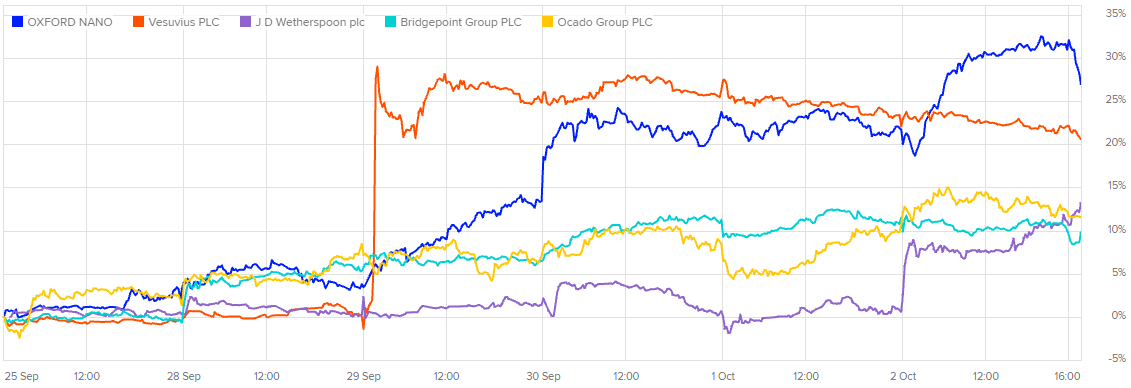
Oxford Nanopore Technologies (LON:ONT), +22.91% to 223.20p, hit a fresh 52-week high of 218.4p on Wednesday and kept going. There were no new trading figures. The run has been building through September. Deutsche Bank raised its target price to 210p on 22 September, and on 16 September the Unified Patent Court, Europe’s patent court, granted an early injunction against rival MGI’s German business. Directors have also been buying shares. The stock went through Deutsche’s target in about a week. Momentum.
Vesuvius (LON:VSVS), +21.03% to 451.20p, has a bid on the table. On Tuesday the molten metal engineering group confirmed it is considering a proposal from Austrian rival RHI Magnesita of 470p in cash plus 0.028 new RHI shares for each Vesuvius share. RHI puts the headline value at 549p, a 47% premium to Monday’s close. Vesuvius’s biggest shareholder, Cevian, has given an irrevocable undertaking to back a recommended offer on those terms, which is a binding promise to vote in favour. RHI has until 5pm on 27 October to make a firm offer or walk away, under the takeover rule known as put up or shut up. Shareholders also keep the 7.1p interim dividend, paid on 8 October.
At 451.20p the shares sit about 18% below the headline value. That gap is the market’s discount for the deal falling through, and for part of the price arriving as RHI shares rather than cash. Signal.
J D Wetherspoon (LON:JDW), +12.89% to 915.00p, rose on results that showed profit falling by more than a quarter. Revenue for the year to 26 July hit a record £2.24bn, up 5.2%, and like-for-like sales rose 4.2%. Like-for-like strips out pubs that opened or closed during the year. Pre-tax profit before one-off items fell 28% to £58.6m as costs climbed, and Tim Martin again blamed VAT, which he says hands supermarkets a price advantage over pubs. The company had already warned on profits four times. On Friday it said like-for-like sales rose 8.6% in the first nine weeks of the new year, helped partly by the weather, and that it expects profit in line with market forecasts of about £74m. After four warnings, in line was enough. Signal.
Bridgepoint Group (LON:BPT), +10.53% to 331.60p, rose without an announcement, including 5.4% on Monday alone. The private equity manager reported record first-half results in July and has raised €26bn towards its €28bn fundraising target for this year. Listed fund managers have had more attention since Pollen Street confirmed take-private talks last week, though I can’t tie this move to that. Momentum.
Ocado (LON:OCDO), +10.06% to 260.40p, had only minor news. On Wednesday The Grocer reported that Ocado is selling a half-acre robotic picking grid, with close to 100 robots, from a general merchandise warehouse in Erith that closes next spring. Its own technology can now handle those non-food lines in the main Erith warehouse next door. The grid up for sale was built by AutoStore, the Norwegian rival that agreed in 2023 to pay Ocado £200m to settle a patent fight. That is housekeeping rather than a new customer win, and it doesn’t explain a 10% move. Noise.
Fallers, FTSE 250
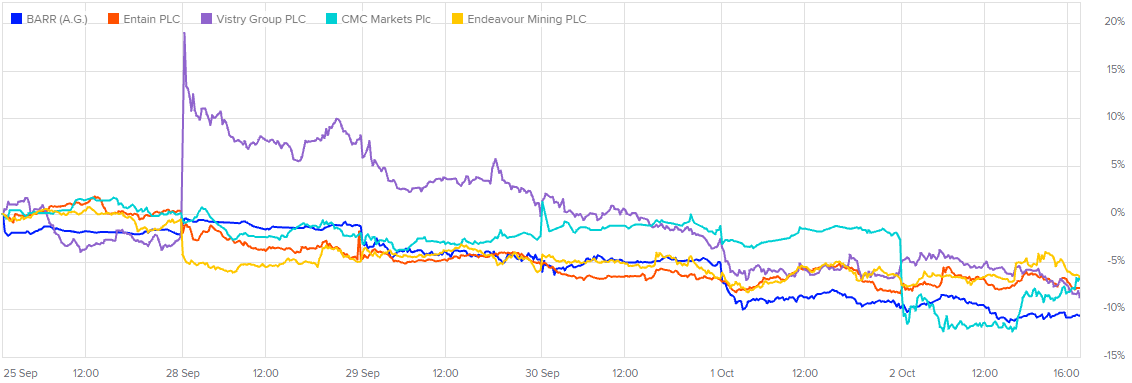
A.G. Barr (LON:BAG), -8.75% to 542.00p, fell after Tuesday’s half-year results. Revenue rose 8.5% to £247.4m, helped by a warm summer and the Fentimans and Frobishers acquisitions. Adjusted pre-tax profit rose only 2.6% to £36.1m, held back by higher interest costs on the debt taken on for those deals. Irn-Bru, 29% of revenue, was flat in the half. The company says the supply chain problems that cost about £10m of sales, flagged in August, are now fixed, and it kept full-year guidance with a stronger second half to come. Sales growth that leans on acquisitions and gets eaten by interest is harder to pay up for. Signal.
Entain (LON:ENT), -8.05% to 413.40p, now shows up in the right index, as the data has caught up with its move to the FTSE 250. It’s on the fallers board for the second week running, again without company news. A tax-raising Budget and a week of rising gilt yields are two good reasons to avoid a UK bookmaker. Macro.
Vistry Group (LON:VTY), -6.72% to 241.60p, made the same round trip as Barratt Redrow but finished lower. It rose 12.3% to 292p on Monday on the Your First Home news, then fell for the rest of the week to end below where it started. The reason sits in last Thursday’s half-year results. Vistry builds many of its homes in partnership with housing associations and councils. It reported an underlying pre-tax loss of £83m against an £81m profit a year earlier, on revenue down 9% to £1.7bn. Net debt rose to £469m, and it now expects to finish the year with broadly zero net cash, down from more than £100m. Full-year profit guidance is now about £165m, and the new plan cuts regional businesses from 25 to 12. A builder with rising debt and a strategy reset has less room to absorb higher mortgage rates. Signal, with Macro on top.
CMC Markets (LON:CMCX), -6.65% to 632.00p, fell on IG’s news rather than its own. CMC dropped as much as 9% on Friday after IG’s update, and Plus500 took the unusual step of putting out its own statement in the middle of the trading day. CMC hasn’t reported anything itself. Noise until its own numbers say otherwise.
Endeavour Mining (LON:EDV), -6.08% to 4,250.00p, comes with a housekeeping note. The data lists it with the FTSE 250, but it is a FTSE 100 member. The move matches Fresnillo’s, as rising bond yields made gold miners harder to own. Macro.
Idea of the week: 6% is the new hurdle
The 30-year gilt now pays about 6% a year, backed by the government, for three decades. Every UK share bought for its income gets measured against that. A bank, a housebuilder or a bookmaker has to offer something extra to justify the risk on top, and this week investors weren’t confident enough in the extra to pay for it.
Look at the fallers that said nothing. Lion Finance, Babcock, Entain, Fresnillo and Endeavour all dropped without a word from the companies. The housebuilders had the clearest round trip of all. Burnham’s scheme sent them up on Monday, and the gilt market took most of it back by Friday.
The risers mostly brought something concrete. Vesuvius has a 549p proposal with a deadline attached, and Wetherspoon delivered a full year of numbers with an in-line outlook. Last week I argued the market was paying for receipts and discounting stories. IG is this week’s reminder that receipts can disappoint as well.
The classifieds dropped off the boards, and Auto Trader was among Thursday’s few blue-chip risers. One quiet week doesn’t settle the AI argument either way.
There are 26 sleeps until the Budget. Healey’s buffer is now measured in gilt yields, and he doesn’t set those. The US jobs figures and the next round of gilt sales will matter as much to his numbers as anything said in Liverpool.
Thanks for reading,
Ollz.
This article is for informational and educational purposes only and does not constitute financial advice. The author may hold positions in securities mentioned. Always do your own research and seek independent financial advice before making any investment decision. Capital is at risk.
Sources
FTSE 100 falls to 10,428.27, its worst day since May, as the 30-year gilt yield breaks 6%, BBN Times
UK chancellor Healey preaches fiscal discipline before budget, Irish Times
Andy Burnham’s speech: the main talking points, CMA Accountancy
Housebuilders surge as Burnham revives Help to Buy, Proactive Investors
Oil prices surge after Trump rejects Iran’s plan to reopen Strait of Hormuz, Al Jazeera
IG Group shares plunge 25% as Peel Hunt flags revenue and margin downgrade, Proactive Investors
FICO stock tumbles on report of credit bureau requirement change, Investing.com
Wetherspoon blames VAT for 28% profit fall, The Spirits Business
Great summary, really helpful for us beginners
Very useful roundup!