

Dear reader,
It was a testing week for Andy Burnham, and not one he can pin on bad luck. On Wednesday inflation came in at 3.1%, up again and pointing the wrong way. On Thursday his own central bank held rates at 3.75% through gritted teeth a 6–3 vote, three members itching to hike, and Governor Bailey warning that a hike gets likelier the longer the energy mess drags on [1]. So the Prime Minister who spent all summer promising to spend his way to growth now has rising prices, a Bank inching towards making his borrowing dearer, and six weeks until his Chancellor stands up to explain how any of it gets paid for. The giveaways were the easy part. The arithmetic is the hard part, and this week it got worse.
None of that improves before 28 October. You’d expect the market to have taken it badly. It didn’t it barely moved, which, given what the rest of the world got up to this week, is almost an achievement.

The rest of the world reached for the brakes
While London stood still, the grown-ups spent the week tightening. On Wednesday the Federal Reserve raised rates for the first time in three years, a quarter-point to 3.75–4%, and did it unanimously, new chairman Kevin Warsh has talked a hawkish game since he got the job, and this week he backed it up [2]. He as good as booked the next hike in for Christmas. President Trump, who wants rates lower and has said so at length, will have enjoyed that enormously. Wall Street didn’t: the Dow shed 600 points on the day before clawing half of it back on Thursday as the tech names dusted themselves off.
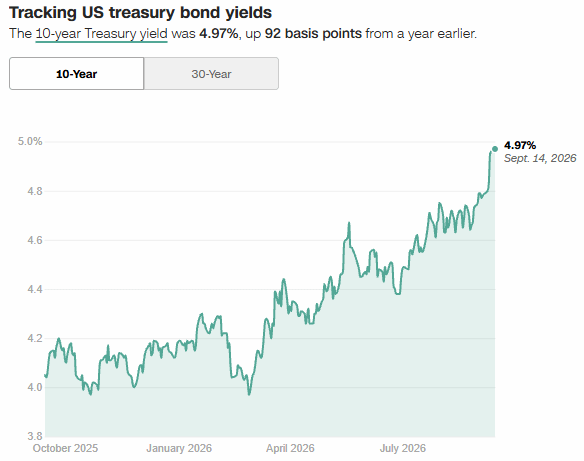
The bond market is the bit to watch. The US ten-year Treasury yield touched 5% this week, a level it hadn’t seen since the last financial crisis [3]. When the world’s risk-free rate pays you five percent, every share on earth has to argue a little harder for your money. And it wasn’t only America, the Bank of Japan hiked on Friday too, the ECB had moved the week before, and against the lot of them Britain’s Bank sat on its hands. The big central banks are tightening into an oil shock, and Threadneedle Street is the one pretending it might not have to. We’ll see how long that lasts.
Oil, the thing that started all this, came off the boil without going cold. Brent slid to around $104, a third straight daily fall, as Saudi Arabia moved to patch up the pipeline damage and get crude flowing again [4] enough to unwind last week’s panic, nowhere near enough to call the energy problem solved. It never dropped below $100 all week.
The index went nowhere. Underneath, plenty happened.
And in the middle of all that, London did almost nothing. The FTSE 100 finished the week where it started, up a rounding error to around 10,659 it climbed midweek on the Bank’s hold and the softer oil price, then handed it all straight back on Friday as the banks and energy names were sold off. Flat, while the world around it hiked rates and dumped bonds. Not a disaster. Not much of anything.
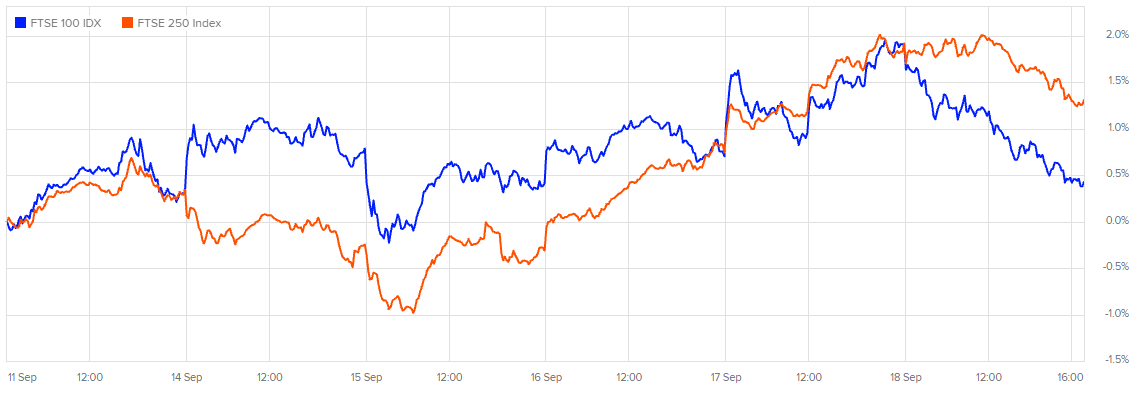
But flat hides a lot. The action wasn’t in the index, it was underneath it, in the mid-caps and the single stocks, where the gap between winners and losers was about as wide as it gets. Look at the riser board and last week’s picture has flipped. A fortnight ago the gainers were basically oil and little else. I said at the time that when the best the blue chips can offer is BP, you’ve had a bad week. This week it’s BAE, Sage, GSK, Kingfisher, Persimmon: a proper spread across defence, software, pharma, retail and housing. The only reason the index still went nowhere is that the two corners doing the winning last week, oil and the miners, did the losing this week, and those are heavyweight names. Broad green, dragged flat by a few big reds.
The movers
A scan of the week, with a verdict on each. Signal means the story genuinely changed. Noise means a move to look past.
Risers, FTSE 100
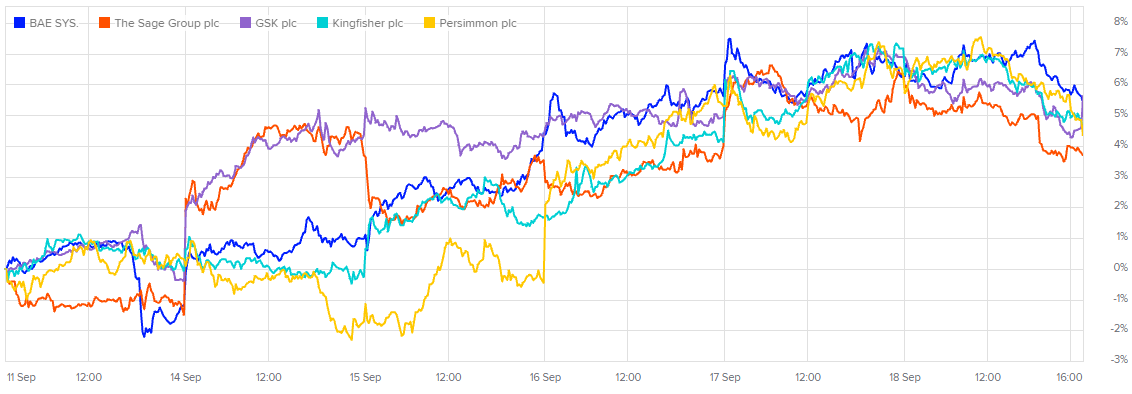
BAE Systems (LON:BA.), +6.90% to 2,029.00p, is the war trade, still running. With the Middle East refusing to calm down, money kept piling into anything that makes weapons, and BAE topped the index on Tuesday while everything else dithered. A $16m US chip award, a bit of Navy contract work, last quarter’s raised guidance underneath. But let’s not kid ourselves: this is the sector catching a geopolitical bid. Macro, with a very healthy order book for company.
Sage (LON:SGE), +5.43% to 1,010.00p, is doing my job for me two weeks running. A fortnight ago it was the biggest faller on the 100, dumped below £10 because money was leaving quality and chasing oil. This week it’s a top riser, back above £10, because the money came back, the story doing the rounds being a sudden bout of nerves that AI is moving too fast, sending investors scurrying towards boring, dependable software they understand. And Sage is nothing if not dependable. No news at the company. Just the mood, swinging like a gate. Rotation.
GSK (LON:GSK), +5.00% to 1,859.00p, actually earned it. Good lung-cancer trial data on two drugs, then a deal to buy a blood-cancer treatment off China’s Chimagen for up to $750m, then a Berenberg upgrade to buy with a £22 target on top [7]. Three bits of good news in five days for a pharma that had spent the year going precisely nowhere. Signal.
Kingfisher (LON:KGF), +4.89% to 302.60p, is the domestic bounce in a tool belt. B&Q and Screwfix’s owner is a leveraged bet on the British punter and his spare room, exactly the sort of thing dumped last week when the oil spike had everyone fretting about rates. This week the panic faded and the beaten-up domestics came back. Don’t mistake it for the Bank turning friendly — it held, but with three members wanting to hike. This was the oil scare lifting, not a green light from Threadneedle Street. Rotation.
Persimmon (LON:PSN), +4.52% to 1,157.00p, is the same trade, purer, and it comes with a nag. A housebuilder lives and dies on the mortgage rate, so a week when the oil-driven rate panic eased was always going to help. But hold the party: the Bank’s leaning towards hiking, not cutting, and the property tax chatter that’s swirled all summer still hangs over the market Persimmon actually sells into, even after Burnham ruled out the full stamp-duty overhaul [10]. Bought the relief, parked the worries. Rotation, for now.
Fallers, FTSE 100
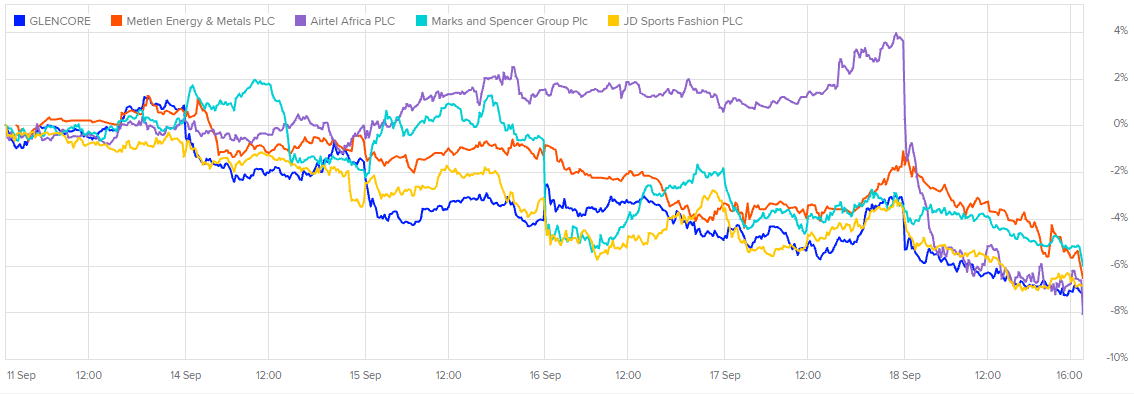
Glencore (LON:GLEN), -7.94% to 557.40p, was the worst blue chip of the week and the exact mirror of a fortnight ago. Two weeks back Glencore scraped a gain while the pure miners got hammered, because it’s only half a metals story, coal, oil and a trading desk propping up the copper and zinc. This week that same mongrel nature bit it: the barrel came off so the energy half stopped helping, and weak China data did for the metals half. Live by the diversification, die by it. Macro.
Metlen (LON:MTLN), -7.06% to €44.24, the Greek energy-and-metals lot, was caught in the identical downdraught, energy softening, metals weak, priced in euros for good measure. No hard catalyst I could find; read it alongside Glencore. Macro.
Airtel Africa (LON:AAF), -6.90% to 321.20p, at least had news. A report it’s mulling a smaller London float for its Airtel Money arm went down badly, and the shares had their worst day in six months as telecoms led Friday’s fallers [5]. Signal.
Marks & Spencer (LON:MKS), -6.25% to 355.30p, is the consumer, still in the doghouse. No disaster just brokers going cold ahead of November’s half-year, Goldman trimming its target, even the fans warning the profit numbers may have to come down. Stack that on the general reluctance to own anything discretionary six weeks before a tax-raising budget and you’ve a soft week. The food halls are heaving; the market’s fretting about the cardigans. Signal, on the caution.
JD Sports (LON:JD), -5.61% to 73.72p, is the same nerves with a date attached. Still nursing August’s profit warning and a rotten North American quarter, it slid into first-half results due on the 23rd. Nobody’s brave enough to buy in front of that. Noise for now, but circle the 23rd.
Risers, FTSE 250
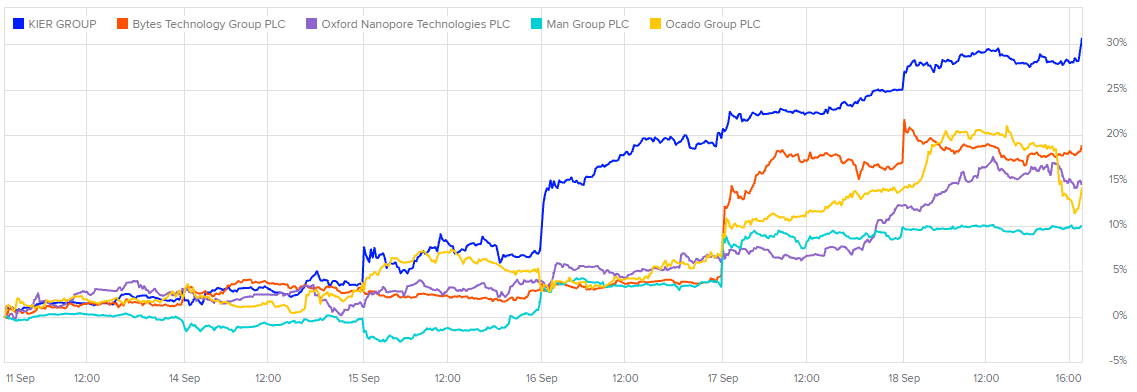
Kier Group (LON:KIE), +25.06% to 308.40p, was the biggest move on either index and the only one that really means something, so I’ve saved it for the bottom. The short version: Tuesday’s full-year numbers were about as clean as construction gets, revenue up 7.5%, a record £11.9bn order book, the first average net cash in over a decade, dividend up, buyback running, guidance to the top end [6]. The shares re-rated all week. Signal, and the biggest of the year.
Bytes Technology (LON:BYIT), +16.09% to 454.60p, is a tidy bookend. A fortnight ago the tech mood curdled and Computacenter gave back record results in a day. This week its near-twin another UK IT reseller, jumped on a guidance upgrade. Same shelf of the shop, opposite outcome. Signal.
Oxford Nanopore (LON:ONT), +11.54% to 175.00p, is the market’s pet of the moment, up something like 60% since early August on the new boss’s turnaround pitch and a $1bn sales dream. Couldn’t find a fresh catalyst this week; it’s the run carrying on under its own steam. Momentum and the kind that gives back a bad week just as fast.
Man Group (LON:EMG), +10.56% to 337.20p, had a real reason. UBS upgraded it to buy and lifted the target, betting the AHL black-box funds back above their high-water marks and free to charge performance fees again will drag the numbers up. Enjoy the irony: a trend-following robot fund cleaning up in the very fortnight the barrel whipsawed and half the human momentum-chasers got minced. Signal.
Ocado (LON:OCDO), +9.73% to 223.20p, is the twitchiest recovery play in London doing its thing, another tenth on top of a 45% month. No hard catalyst I could pin this week; read it as momentum and short-covering on a name that’s finally found some friends. Momentum, high-beta.
Fallers, FTSE 250
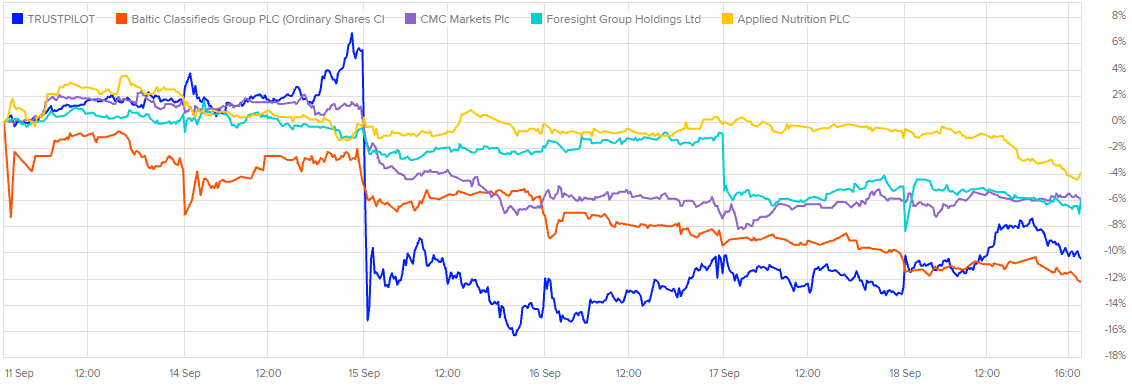
Trustpilot (LON:TRST), -11.46% to 222.60p, is the bill arriving for a call I made last week. I told you the numbers were the thing to watch, and they landed Monday looking a state, cracking underlying growth, revenue up 23%, EBITDA up 46%, all of it buried under a swing to a net loss, an Italian fine, a self-inflicted US sales-tax error and slipping retention [8]. After a year of upgrades, a messy set with accounting hair on it gets no mercy at that price. Signal, second week running.
Baltic Classifieds (LON:BCG), -9.02% to €2.22, the Lithuanian classifieds business, is an expensive quality name that missed the rotation party Sage went to. No catalyst I could find, a give-back in a pricey euro grower while the cash went to UK value. Noise.
CMC Markets (LON:CMCX), -7.41% to 687.00p, gave back a slug after a storming year. Nothing behind it but a routine shareholder notice, though it’s worth noting a spread-betting shop sits right in the budget’s line of fire, in the same tax-fear shadow hanging over the whole gambling-and-leverage crowd. A give-back with a nervous edge. Noise.
Foresight Group (LON:FSG), -6.46% to 441.50p, the clean-energy and infrastructure fund manager, drifted with no obvious trigger, a rotation loser in a week that wanted domestic cyclicals, not alternative-asset gatherers. Noise.
Applied Nutrition (LON:APN), -6.26% to 269.50p, the Liverpool protein lot, handed back some of last month’s pop. No fresh news but the cloud over it is the same one that helped sink THG a fortnight back, the whey-price spike squeezing everyone who sells protein by the tub. Full-year figures in November. Noise, with a whey-shaped stain on it.
Idea of the week: follow the government’s money
Last week I told you to watch the gap between what the government says and what the trading updates actually show. This week both sides turned up, and they lined up either side of the budget so neatly it was almost rude.
Start with the direction of travel. Over the summer Healey floated a plan to borrow something like £9bn a year by the end of the decade to take stakes in infrastructure, housing and industry [9], modest against a state that spends more than a trillion, and the bond crowd sniffed at it as small fry, but it told you exactly where this government’s head is. Burnham wants to build.
Now look at Kier. A firm nobody wanted to own for a decade posted a record £11.9bn order book this week, and that order book reads like the invoice for precisely what a build-Britain government wants to buy, Sizewell, fusion, hospitals, railways [6]. When the state decides to pour concrete, Kier is one of the outfits holding the trowel. The market added a quarter to it in five days. The results did the heavy lifting but the reason it ran this hard is the budget, quietly pricing itself in.
Then the other pile. M&S and JD Sports, the high-street names Burnham says he wants thriving spent the week getting sold, on broker caution and on nobody wanting to hold a shopkeeper into a tax-raising budget. And in the daftest twist of the week, the housebuilders rose on the promise of state spending even as the property-tax rumours hung over the market those same builders sell into. Bought the giving hand, blanked the taking one. Somebody’s going to be wrong about that.
Here’s the bit to hold onto. A month ago the budget was pure fear: Rank falling on a gambling-tax whisper, retailers sold on nerves. This week it looked more like something you could position around. The government has been fairly clear about where the money is meant to go, which is into the ground. So it’s worth watching the consumer for what the 28th might take, and the contractors, Kier and the rest of the build-Britain names, for where it might land. This week the market paid up for shovels and marked down the tills. Whether that holds is another question, and with the global bond market now demanding five percent, the cost of all that borrowing is likely to stay in the conversation.Thanks for reading,
Ollz
This article is for informational and educational purposes only and does not constitute financial advice. The author may hold positions in securities mentioned. Always do your own research and seek independent financial advice before making any investment decision. Capital is at risk.
Sources
[1] Bank of England / CNBC — MPC holds Bank Rate at 3.75% (6–3), CPI 3.1% in August — https://www.bankofengland.co.uk/monetary-policy-summary-and-minutes/2026/september-2026
[2] U.S. Bank / CNBC — Fed hikes to 3.75–4.00%, first in three years, Warsh — https://www.usbank.com/investing/financial-perspectives/market-news/federal-reserve-interest-rate.html
[3] CNBC — US ten-year tops 5%, Dow falls then rebounds, global central banks — https://www.cnbc.com/2026/09/17/stock-market-today-live-updates.html
[4] NordFX / Tickmill — Brent eases to ~$104 (third daily fall), stays above $100; BoJ hikes to 1.25% — https://nordfx.com/market-news/market-pulse-september-18-2026
[5] Reuters via Investing.com — FTSE weekly wrap / Airtel Money — https://www.investing.com/news/economy-news/londons-ftse-100-retreats-as-banks-energy-weigh-but-eyes-weekly-rise-4906988
[6] AskTraders — Kier FY26 results — https://www.asktraders.com/analysis/kier-group-shares-rise-after-fy26-results-beat-and-upgraded-fy27-guidance
[7] ad-hoc-news / Reuters — GSK Chimagen deal, lung-cancer data, Berenberg upgrade — https://www.ad-hoc-news.de/boerse/news/corporate-news/gsk-stock-gains-on-usd-750-million-blood-cancer-drug-deal-and-analyst/70107260
[8] AskTraders — Trustpilot H1 results — https://www.asktraders.com/analysis/trustpilot-shares-plunge-18-6-on-self-disclosed-accounting-missteps/
[9] CityAM / The Times — Healey’s ~£9bn-a-year borrowing plan (reported August) — https://www.cityam.com/investors-may-be-less-than-impressed-by-john-healeys-9bn-borrowing-plans/
[10] HomeOwners Alliance — Burnham rules out scrapping stamp duty — https://hoa.org.uk/news/new-property-tax/