

Dear reader,
A couple of weeks ago the mood in London was quietly hopeful. Oil was easing on hopes the Strait of Hormuz would reopen, gilt yields were softening with it, and the rate-sensitive names that had spent two years in the sin bin were catching a bid. I wrote at the time that all of it rested on the barrel staying down, and that if the Hormuz talks fell apart the move would unwind. The talks fell apart. American and Iranian forces went back to trading blows in and around the Strait of Hormuz, with fresh attacks on shipping and Gulf energy sites and Iran warning it was ready for a more intense fight. Brent did not drift, it bolted, back above $100 and on to a four-month high [1]. Most of what floated on cheap oil a fortnight ago sank this week.
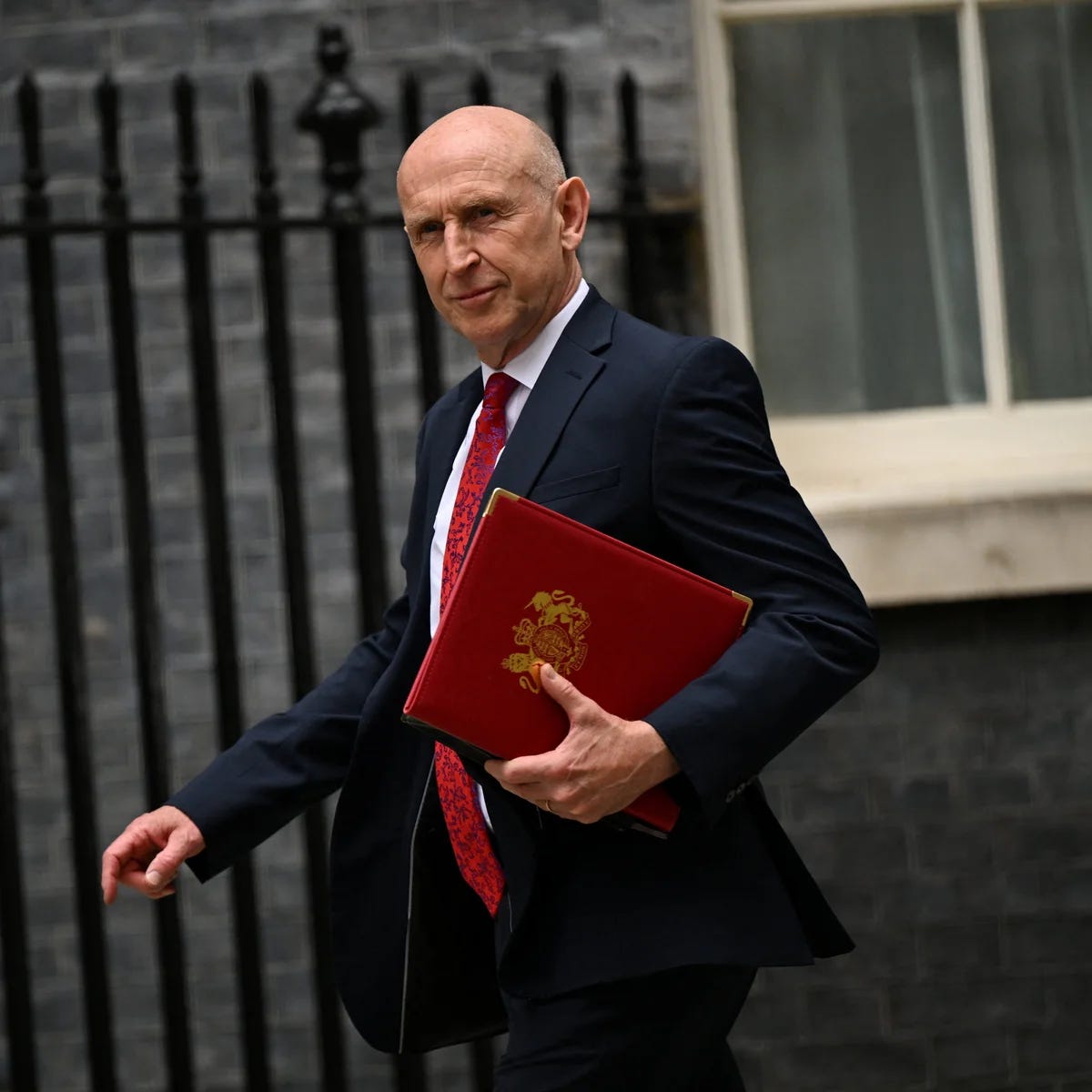
But the barrel is not the story I want you carrying into the autumn. Westminster is. We have a new government, in the loosest sense of the phrase. Same party, new man. Andy Burnham walked into Downing Street in July as the “King of the North”, took over from Keir Starmer without a shot being fired, and has spent the summer handing out sweeteners. VAT knocked off your electricity bill from October, a business rates break for the pubs, warm words about reindustrialisation and a “circuit breaker for Britain”. Lovely stuff, and all of it the easy part. The hard part has a date on it now. His Chancellor, John Healey, stands up on 28 October to deliver his first budget, and he has to find the money to pay for every one of Burnham’s pledges [2]. The summer was the giveaways. The autumn is the bill, and the market has started totting it up.
You can see where the bill lands. It lands on whatever the Treasury can tax without breaking a manifesto promise. Burnham has ruled out touching income tax, VAT and National Insurance, the three that raise the real money [3], so the rest has to come from the awkward corners, and the most budget-sensitive corner of the London market took the brunt this week. More on that when we reach the fallers. Add a spiking oil price, which revives the inflation worry and nudges gilt yields back up, and the parts of the market that live on cheap borrowing and a spending consumer had a rotten five days.
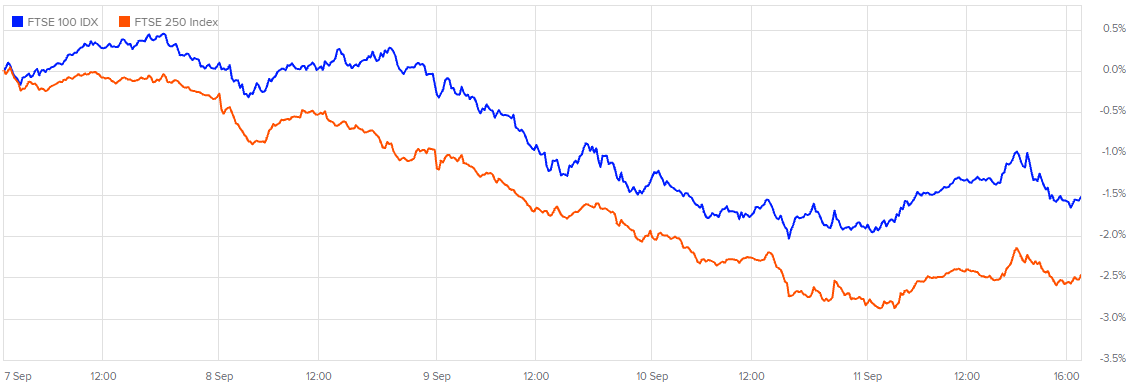
Oil, and not much else
The week in numbers first, to set the scene. The FTSE 100 fell for five sessions straight and closed Thursday at a seven-week low around 10,610, its worst week since early July. The FTSE 250 had its sharpest weekly drop in more than four months. Brent crude did most of the damage, up roughly 13% on the week to a four-month high near $110 before easing back on Friday as talk of a Strait shipping deal resurfaced [1]. The one bright spot came from the economy rather than the market, with UK output growing 0.4% in July against a forecast of nothing at all.
The oil majors led the FTSE 100 this week, or rather they were the only thing holding it up. Look at the riser board and the top name is up four and a half percent while the fifth is up half a percent. When the best the blue chips can offer you is BP, the index has had a bad week. Underneath, the money came out of the quality compounders and the growth names that led in August, out of the consumer, and into the barrel and very little else.
The movers
A scan of the week, with a verdict on each. Signal means a genuine change in the story. Noise means a move to look past.
Risers, FTSE 100
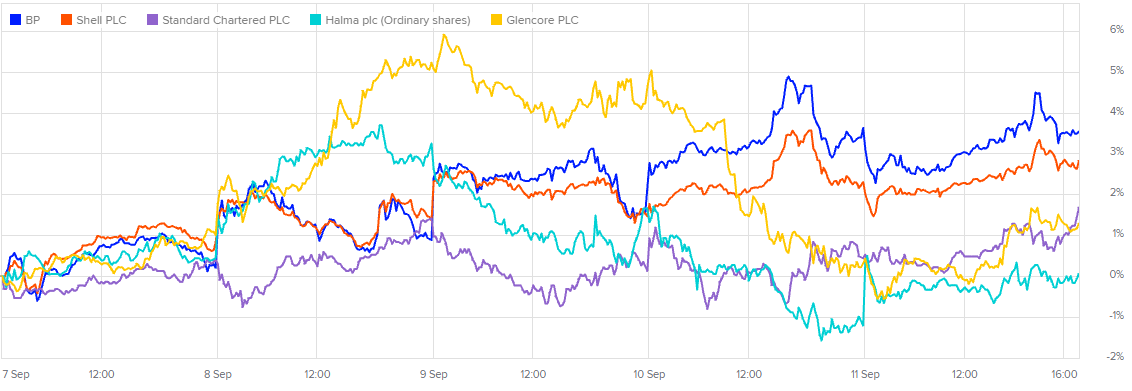
BP (LON:BP.), +4.56% to 564.30p, is the clearest read on the week. A fortnight ago BP was the biggest faller on the 100 as oil eased. This week it is the biggest riser as oil bolted. Nothing changed at the company, everything changed in the Strait of Hormuz. Macro, and about as pure as macro gets.
Shell (LON:SHEL), +3.32% to 3,551.00p, is the same trade in a bigger boat. Macro.
Standard Chartered (LON:STAN), +2.41% to 2,298.00p, had a bit more behind it than the rest of this list. JPMorgan lifted its price target on the bank to 2,470p this week, nudging an already strong performer to fresh 52-week highs. It helped that in a week ruled by the UK budget and UK gilt yields, an emerging-markets lender that earns its keep in Asia, Africa and the Middle East held up while the domestic banks were sold on bond-market nerves. Signal on the upgrade, rotation on the rest.
Halma (LON:HLMA), +0.83% to 3,634.00p, the safety and sensors group, barely moved, and barely moving was enough to make the riser board this week. That tells you more about the week than about Halma, a quality defensive holding its ground while the rest wobbled. Noise.
Glencore (LON:GLEN), +0.52% to 604.80p, rounds out a very thin list, and it is the odd one out. The other big miners fell hard this week as metals came off, Anglo American and Antofagasta both down more than five percent on Thursday alone. Glencore scraped a gain because it is only half a metals story. Coal, oil and a giant commodity-trading arm sit alongside the copper and zinc, so an energy-led week that punished the pure miners left Glencore roughly flat instead. Macro, and barely there.
Fallers, FTSE 100
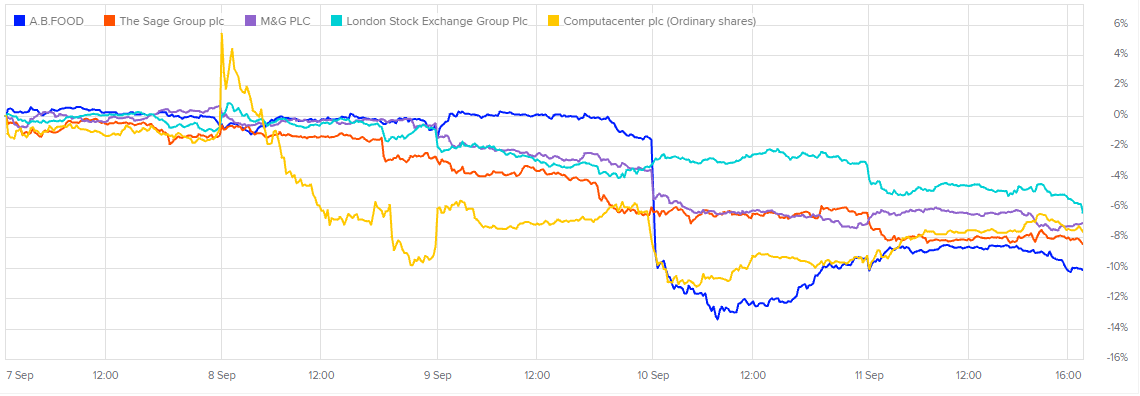
Associated British Foods (LON:ABF), -11.03% to 1,843.50p, was the worst blue chip of the week, and it did it to itself. The Primark owner’s trading update on Thursday landed with a thud [5]. Continental Primark sales still going backwards, like-for-likes down more than four percent in Europe, and a sugar business now expected to lose somewhere between £70m and £170m next year on cheap European sugar prices and dear gas. Management insists full-year earnings will still come in ahead of hopes, and Primark is finally going to deliver clothes to your door, but investors looked past all of it to the sugar hole and the soft European shopper. The heatwave got a mention too, of which more later. Signal.
Sage Group (LON:SGE), -8.89% to 958.00p, had no disaster, just the tide going out. The accounting-software group has no bad news to point to and its cloud revenue is still growing nicely, but it is exactly the kind of expensive, dependable grower that gets sold when money rotates towards oil and value. It slipped below £10 a share on nothing more than a change of mood. Noise, though the mood is the thing worth noticing.
M&G (LON:MNG), -6.99% to 332.40p, is not the mechanical story it first looks. The savings and investment group did go ex-dividend this week, which knocks the next 6.8p payout off the price, but that is barely two points of a seven percent fall. The rest is the shares sliding back since half-year results on 3 September, giving up ground after a strong year that had carried them past where the analysts had them pegged, with the bond-yield nerves that dog every income stock doing the rest. A little mechanical, mostly a give-back.
London Stock Exchange Group (LON:LSEG), -6.77% to 8,238.00p, gave back a fortnight ago’s gain. Two editions back I wrote that money was quietly returning to this high-quality data-and-index compounder. This week it quietly left again. No news, just the same rotation out of quality and into the barrel. Noise.
Computacenter (LON:CCC), -6.62% to 5,220.00p, was a genuinely odd one. The IT reseller reported record half-year figures on Tuesday, revenue up by more than two thirds, a raised full-year outlook and a record £9.3bn order book [8]. The shares spiked to a fresh high on the day, then spent the next two sessions handing all of it back and then some. This is a stock that had already more than doubled in a year and led the entire index a fortnight ago on Nvidia’s coat-tails. Buy the rumour, sell the fact, then sell a bit more as the tech mood soured. The numbers were strong. The share move was froth coming off a stock that had run too hard into them. Signal, on the results rather than the price.
Risers, FTSE 250
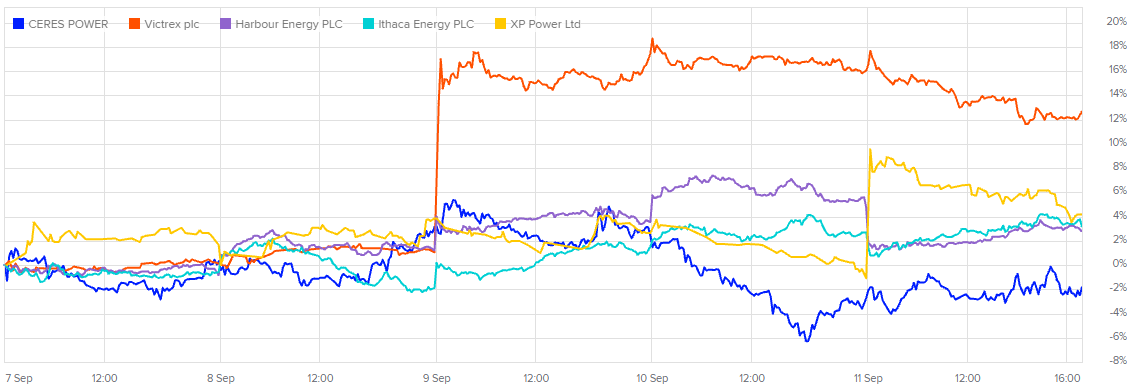
Ceres Power (LON:CWR), +13.67% to 409.20p, the Horsham fuel-cell group, is a reminder that this is one of the twitchiest stocks on the London market. It is up several hundred percent over the past year on the idea that its solid oxide cells will power AI data centres, it makes no profit, and it can swing ten percent in a session on sentiment alone. This week sentiment was kind. I could not pin a hard catalyst to it, so read it as a very high-beta momentum name doing what it does, with the data-centre-power story that has powered it all year still humming in the background. Noise, though the kind of name that can hand back a fifteen percent fall just as easily next week.
Victrex (LON:VCT), +11.32% to 964.00p, earned its rise. The high-performance polymer maker put out a pre-close update lifting full-year profit guidance, with growth across aerospace, electronics and its resellers, and strong demand in Asia [7]. This is a business that took a nasty impairment on a Chinese plant earlier in the year and has spent the months since cutting costs and steadying itself, so a guidance upgrade off that low base gets rewarded quickly. The same pattern as Hays a fortnight ago, the market paying up smartly for a mid-cap that proves its earnings are turning. Signal.
Harbour Energy (LON:HBR), +5.64% to 273.40p, and Ithaca Energy (LON:ITH), +4.47% to 285.20p, are the North Sea end of the oil trade lifting BP and Shell. When the barrel jumps, the smaller producers geared to it jump harder. Macro, both.
XP Power (LON:XPP), +4.75% to 1,896.00p, is a different animal from Ceres despite sitting near it on the board. It makes the power supplies that run semiconductor manufacturing kit, medical devices and industrial electronics, and after years in the wilderness its order book has been recovering on the back of the chip upcycle, with semiconductor demand the standout in its August half-year. No fresh news this week that I could find, so read the move as a beaten-up, high-beta recovery name riding chip-sector sentiment. Momentum, on the semiconductor cycle.
Fallers, FTSE 250
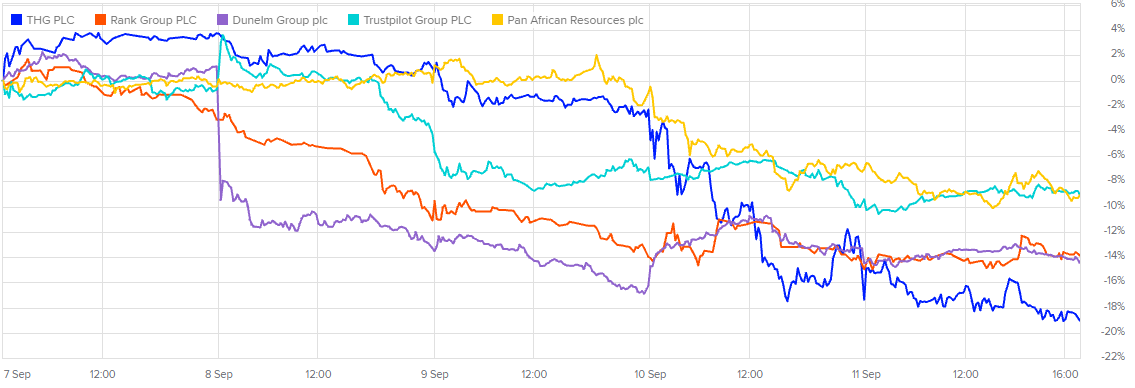
THG (LON:THG), -20.71% to 26.26p, was the biggest faller on either index, and another good-news-punished-anyway story. In half-year figures on Thursday, the Manchester group behind Myprotein and Lookfantastic beat its own guidance, doubled its profits and shifted a record pile of protein [6]. Then it told the market that third-quarter growth would slow to around two percent, blamed a new EU beauty tariff, record whey prices and, yes, the heatwave, and the shares fell off a cliff. This is a fragile turnaround trading near its lows, and a fragile turnaround gets no benefit of the doubt on a soft outlook. Signal, and a brutal one.
Rank Group (LON:RNK), -14.81% to 87.40p, is that most-tax-exposed corner I promised you. The Grosvenor casino and Mecca bingo owner flinches at the faintest budget rumour, and this week there was a solid one. The Times reported that the Treasury is modelling a rise in Machine Games Duty, the tax on the slot machines that fill casinos, bingo halls and betting shops, ahead of the budget [4]. Last November’s raid clobbered online gaming and left the land-based estate alone, which was exactly Rank’s shelter, since its money comes from Grosvenor’s tables and machines and Mecca’s bingo rather than an online book. Take a knife to land-based machine duty and that shelter goes, with a 25% rise in Gambling Commission licence fees already due in October on top. Investors did not wait for confirmation, they sold. Second week of heavy falls, and the clearest case of the budget moving a share price before it has even been written. Signal.
Dunelm (LON:DNLM), -14.79% to 752.00p, gained market share and grew its sales in Tuesday’s full-year results, but the profit came in flat and shy of hopes, and then the homewares chain unveiled a three-year investment plan that keeps next year’s profit flat too while it spends [8]. Jam tomorrow, and a soft start to the new financial year with, once again, the weather blamed for slow homeware sales. A broker cut it to a sell the very next day for good measure. Signal.
Trustpilot (LON:TRST), -10.98% to 251.40p, the reviews platform, is expensive, barely profitable, and exactly the kind of racy tech name that gets sold when the growth-to-value rotation is running. It slid into its full results, due in the middle of this month, on no fresh news of its own. Noise, though those numbers are the near-term thing to watch.
Pan African Resources (LON:PAF), -9.80% to 123.40p, is the gold producer giving back a slice of a very big run. Gold went vertical in August, this small South African miner went vertical with it, and this week the metal cooled and the leverage worked in reverse. High-beta, moving on the gold price rather than anything happening at the mine. Macro.
Idea of the week: the budget is the story now
Look past the barrel and the shape of the autumn is political. We have a Prime Minister who spent the summer being popular, which is the easy bit, and a Chancellor who has to pay for it on 28 October, which is not. Andy Burnham took over in July promising a “circuit breaker” and a new economic model, and he opened with the crowd-pleasers, VAT off your electricity, a break for the pubs, big talk about rebuilding British industry. None of it is free. The public finances are stretched, borrowing costs are climbing, and the tax take is already at a post-war high. Something has to give at the budget.
Here is the tension for anyone holding UK shares. Burnham has ruled out the three big levers, income tax, VAT and National Insurance. That leaves Healey hunting for the money in narrower, softer places, and you can map the most exposed of this week’s fallers straight onto them:
Gambling is the obvious one, and the hardest hit. The reports that the Treasury is now eyeing casino and betting-shop slot machines are the whole reason Rank fell out of bed.
Then the consumer, more by association than by direct threat. Nobody wants to hold discretionary spending six weeks before a tax-raising budget, so Dunelm and the rest of the retailers get no forgiveness on a soft quarter.
And the gilt market, which is less a target than a fence around what Healey can do. Bond investors size up every new Chancellor the way they have since Truss, and while they are doing it, yields stay sticky and the rate-sensitive names stay capped.
None of it is confirmed, and that is the point. The market is not reacting to the budget. It is flinching at the guesses, and it has six more weeks of guessing left to do.
There is an irony sitting inside it. Burnham wants to reindustrialise Britain, and the one British industrial that actually worked this week, Victrex with its aerospace polymers, did so on its own results, with nothing from Westminster behind it. The domestic consumer economy he most wants to help is the bit the market spent the week selling. Between now and the 28th, watch the gap between what the government says and what the trading updates show.
Thanks for reading,
Ollz
This article is for informational and educational purposes only and does not constitute financial advice. The author may hold positions in securities mentioned. Always do your own research and seek independent financial advice before making any investment decision. Capital is at risk.
Sources
[1] Reuters (via AOL), https://www.aol.com/articles/london-stocks-rebound-crude-retreats-102953000.html
[3] Grant Thornton, https://www.grantthornton.co.uk/insights/autumn-budget/
[4] The Times (via NEXT.io), https://next.io/news/regulation/uk-chancellor-reportedly-mulling-slot-tax-hike/
[5] AskTraders, https://www.asktraders.com/analysis/associated-british-foods-shares-plunge-on-trading-update-despite-primark-resilience
[6] AskTraders, https://www.asktraders.com/analysis/thg-shares-slide-8-despite-beating-h1-guidance
[7] AskTraders, https://www.asktraders.com/analysis/victrex-shares-jump-14-after-turnaround-signal-lifts-fy26-profit-guidance
[8] MarketScreener / Alliance News, https://www.marketscreener.com/news/winners-losers-oil-up-dunelm-down-computacenter-rises-then-falls-ce785bd8da8dff2d
Can we now go ahead and short Ceres Power?