

Dear reader,
UK housebuilders surged on Monday 28 September. Persimmon (LON:PSN) rose 14.6% to 1,322.25p and Barratt Redrow (LON:BTRW), the country’s largest builder, climbed 14.4% to 353.35p. At one point Barratt Redrow was up 16%, its biggest intraday move since 2020.
The rest of the sector followed. Taylor Wimpey (LON:TW.) gained 13.4%, Bellway (LON:BWY) 13.3% and Vistry (LON:VTY) 12.3%. Vistry’s bounce came only days after its new boss set out plans to shrink the business sharply.
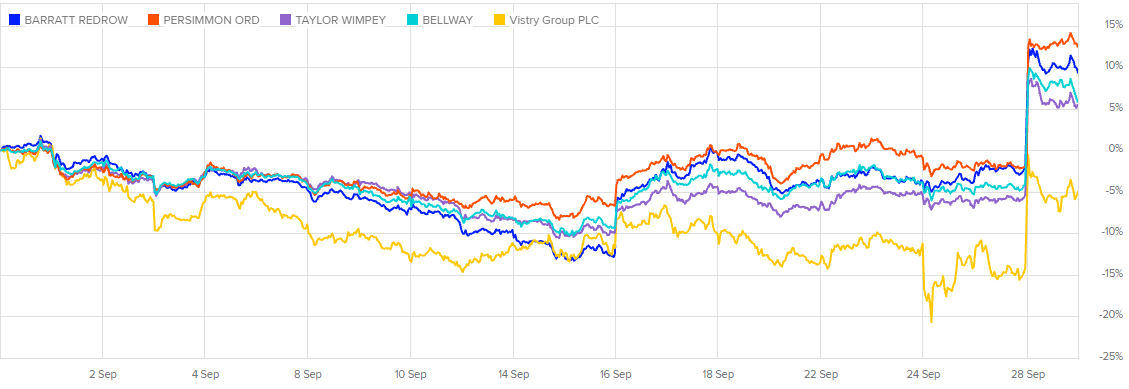
The trigger was a weekend announcement from Prime Minister Andy Burnham. On Saturday he unveiled Your First Home, a state-backed equity loan for first-time buyers of new-build homes. The City read it for what it is: Help to Buy, three years after it was switched off.
Your First Home in plain English

A first-time buyer in England puts down a 2.5% deposit on a new-build home. The government then lends them 20% of the property’s value as an equity loan, and a normal mortgage covers the remaining 77.5%.
Under the old Help to Buy, an equity loan was not a fixed sum like a mortgage. The government took a share of the home’s value, so if the house rose in price the amount owed back rose with it. The new scheme is expected to work the same way, though its terms are not yet published. The loan will be interest-free for an initial period, though the length of that period has not been set.
There will be a household income cap and a local price cap, so support is aimed at buyers who genuinely cannot raise a deposit. Full details are due in the Budget on 28 October, and pre-registration is expected to open before the end of 2026.
The loan can only be used on new-build homes, and first-time buyers have no property to sell, so the direct boost lands with the housebuilders. Some knock-on effect on the wider market is likely, but the builders are first in line.
Why the market cares: the last time round
The original Help to Buy equity loan ran in England from 2013 to 2023 on almost identical terms: up to 20% of a new-build’s value (40% in London from 2016), interest-free for five years. Investors remember what it did to the builders’ accounts.
Between April 2013 and September 2018, 38% of all new-build sales were backed by a Help to Buy loan. The National Audit Office found the scheme helped five of the six largest developers sell more homes year after year, lifting their annual profits.
Persimmon was the poster child. By 2018 around half its sales went through the scheme, pre-tax profit passed £1bn and operating margins hit 30.8%. Taylor Wimpey’s then chief executive reckoned Help to Buy had added 4% to 5% to new-build prices.
The years since have been hard. Builders have struggled since the scheme closed in 2023, squeezed by higher mortgage rates, stubborn inflation, rising build and labour costs, and a sluggish economy. A replacement for the old support is the one lever the sector could not pull for itself.
Who gains most
The market sorted the sector by price point within an hour of the open. Builders selling cheaper homes to first-time buyers rallied hardest, while the top end barely moved.
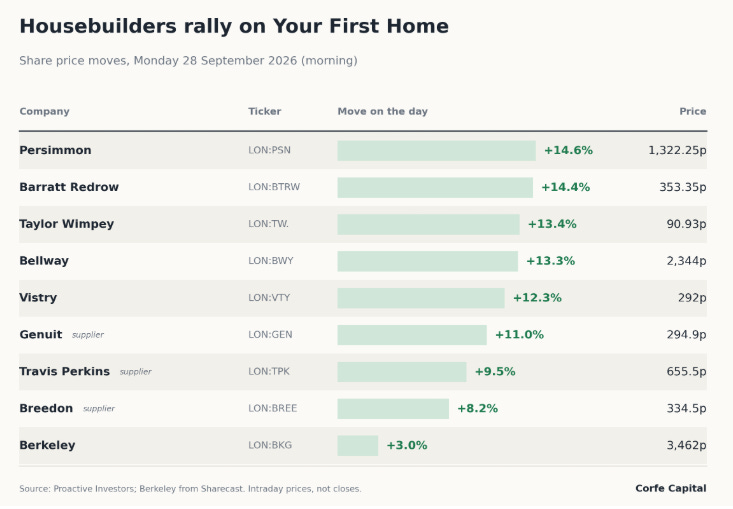
Persimmon is widely seen as the clearest winner. Its average selling price is low and its buyers skew towards first-timers, particularly in the North, where cheaper homes should sit comfortably under a local price cap. Berkeley (LON:BKG), with its London-heavy, high-price book, is expected to gain least.
RBC’s Anthony Codling expects the bigger, more liquid names to benefit most, singling out Barratt Redrow, Persimmon and Taylor Wimpey. Vistry is an odd case: its recent overhaul points it towards open-market sales, which leaves it better placed than its week-old share price suggested.
The rally spread down the supply chain too. Genuit (LON:GEN), Travis Perkins (LON:TPK) and Breedon (LON:BREE) all rose sharply, and even kitchen maker Howden Joinery (LON:HWDN) gained 4.3%.
The catches
Monday priced in a scheme that does not yet exist on paper. The detail that decides how much of the benefit reaches builders’ profits arrives on 28 October, and several pieces of it could cut the other way.
The biggest unknown is what builders will have to pay to take part. Panmure Liberum warns that a high contribution would limit take-up, and even a moderate one could lock out weaker balance sheets such as Crest Nicholson (LON:CRST). The broker also expects the scheme to take a couple of years to feed through properly to sales.
Politics is the second risk. The old scheme was criticised for inflating new-build prices and fattening developer margins, and the Budget will be read for safeguards that turn demand into extra homes rather than higher prices. Tight income and price caps would protect the Treasury but shrink the pool of eligible buyers.
The taxpayer’s exposure is real as well. The National Audit Office noted that equity loans lose value when house prices fall, so a weak market would leave the Treasury nursing losses.
Finally, the scheme only deals with the deposit. Buyers still need a mortgage on 77.5% of the price at today’s rates, and builders still face higher material costs, with the Iran war adding to the bill.
Verdict
The announcement is a genuine positive for the sector, and the direction of Monday’s move is hard to argue with. The size of it is another matter. A 13% to 15% jump across an entire sector has been made on a headline, with none of the terms yet published.
Help to Buy worked for builders because it ran for a decade on generous terms. Your First Home arrives with income caps, price caps and a possible builder contribution already trailed. A tighter version could still lift volumes, but it is unlikely to deliver the margins of 2018.
The points worth reading closely on 28 October:
how much builders must contribute to join, and whether it shuts out the weaker names
where the local price caps sit, which decides how far the benefit reaches beyond the North
how long the interest-free period lasts, since that shapes affordability for buyers
whether the scheme has an end date, which matters for how much land builders will commit
Until those answers land, Monday’s gains are priced on memories of the 2013 to 2023 scheme.
Ollz.
Thanks that was a helpful article.
That was my thinking too. While I’m glad to see it as a shareholder, I am a little less comfortable than the industry is essentially relying on government support.