

Dear reader,
Two very different RNS announcements landed on Wednesday morning. Greggs (LON:GRG) put out a third-quarter trading update that was better than the first half, then tucked a proposal to close up to four manufacturing sites into the same release. Liontrust Asset Management (LON:LIO) announced a deal to buy the fund and model portfolio business of Hawksmoor, a multi-asset boutique with around £1.9bn under management.
Neither is a transformational event. Both, though, say quite a lot about where each business thinks its next few years of profit will come from.
Greggs Q3 Trading Update
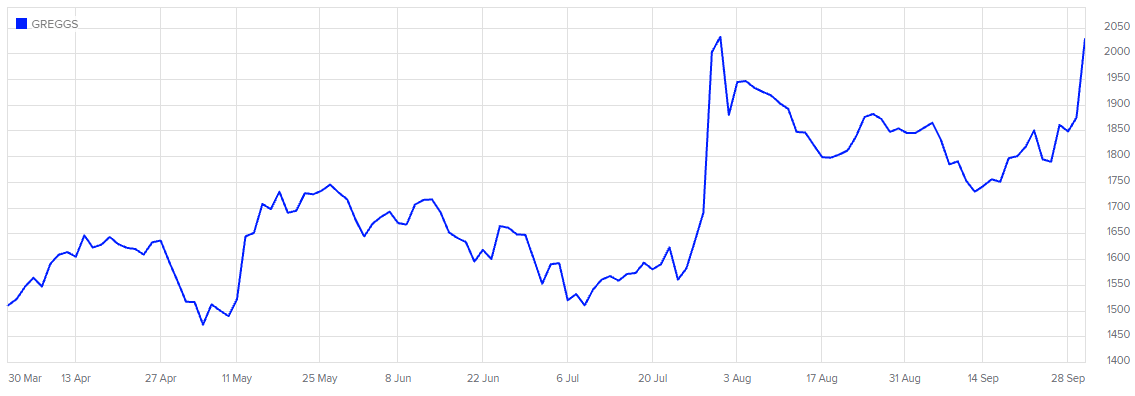
Greggs is selling more through its existing shops than it was earlier in the year. Like-for-like sales in company-managed shops rose 3.4% in the 13 weeks to 26 September. That measure strips out new openings and compares the same shops against the same period last year. Total sales, which include the new shops, rose 7.7%.
For the year to date, like-for-like growth is 2.6%. Doing the arithmetic backwards, that implies the first half ran at a little over 2%, so the third quarter marks a clear step up. Management credits two things: new products and “more settled weather” in August and September. The weather point is worth holding lightly. It flattered the comparison this year and will not necessarily be there next year.
The product point has more substance. Iced drinks (Matcha and Cherry Lemonade were singled out), a salad relaunch and a push into protein-led and functional drinks all get a mention. Drinks and healthier lines matter because they widen Greggs beyond the sausage roll and the lunchtime rush, and they tend to carry decent margins. The autumn menu leans back on the core, with a Steak & Stilton Bake launch described as highly successful.

The shop estate reached 2,796 at 26 September: 2,157 company-managed and 639 franchised. So far this year Greggs has opened 95 and closed 38, with 20 of those closures being relocations, for 57 net new shops. Guidance of 100 to 110 net openings for the full year is unchanged. That leaves roughly 43 to 53 to come in the final quarter, a heavily back-loaded year. It is a number to check when full-year results arrive.
Greggs: closing sites to build capacity
The headline most people will read is the manufacturing consolidation. Greggs has opened a consultation on proposals that could close four sites, with around 740 roles potentially made redundant over two and a half years.
This is not a retreat. Greggs makes most of what it sells, and it is spending heavily on capacity foutlook or at least 3,500 shops, including new distribution centres in Derby and Kettering. The review is about where that production should sit once the new capacity is in place. Put simply, older and smaller sites get folded into bigger, more automated ones.
The numbers:

A £20m annual saving on a £60m one-off spend pays back in about three years once fully running. For context, that saving is a meaningful sum against the cost pressure Greggs is flagging for 2027, when the new distribution centres add overheads before they start earning their keep.
The risks are mostly in the execution. Moving production lines while supplying a growing estate is the kind of project that can create availability problems in shops, and a two-and-a-half-year programme gives plenty of time for costs to drift. There is also a reputational angle. Greggs has built a strong image as a good employer, and a consultation with unions over 740 jobs will attract attention, particularly in the regions where the sites are located. The update does not name the four sites.
Outlook
The guidance change is small but in the right direction. Greggs now expects a “modestly improved outcome” for 2026, helped by better recent trading and cost inflation holding at around 2% on a like-for-like basis. Like-for-like here means the same basket of costs compared year on year, before the effect of a bigger estate.
The caveat sits in the same paragraph. Management sees signs of greater inflationary pressure in 2027, and the Derby and Kettering overheads land that year too. So 2027 looks like a year where costs rise faster than the benefits show up, with the manufacturing savings not arriving until 2028 and 2029.
On balance this was a solid update. The story has shifted from a slower first half to a business that looks to be steadying, while being honest that next year will be a heavy one for costs.
Liontrust: what it is buying
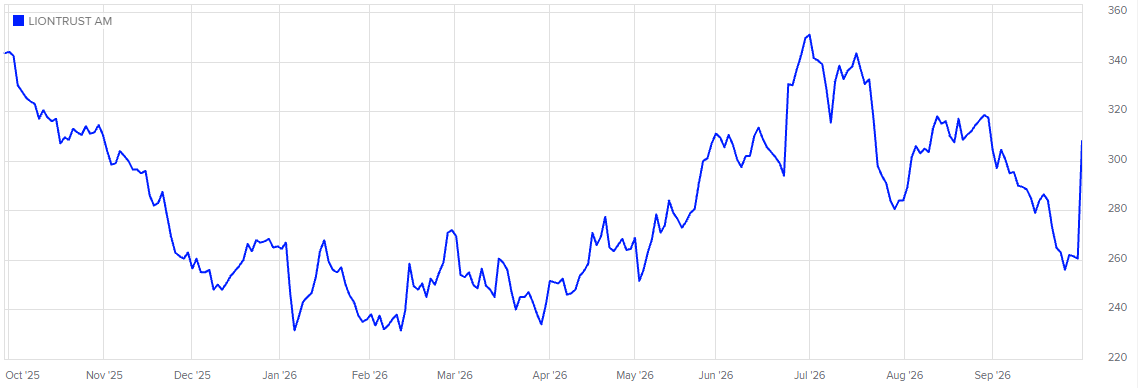
Liontrust is paying £6m in cash up front for Hawksmoor’s fund management and model portfolio services (MPS) business. Two further payments of up to £2m each follow at 12 and 24 months, but only if revenue holds up. That makes the total up to £10m, all from existing cash, with no new shares issued. The seller is Hawksmoor Investment Management, part of Shackleton Advisers, and completion is expected by 31 December 2026.
A model portfolio service, for anyone unfamiliar, is a set of ready-made portfolios that a financial adviser can put clients into. The fund manager picks and rebalances the holdings; the adviser handles the client relationship. It is a fast-growing part of the market.
What Liontrust gets, as at 31 August 2026:

The three funds are the MI Hawksmoor Vanbrugh, Distribution and Global Opportunities funds. Vanbrugh and Distribution sit in the top quarter of their sectors over one, three and five years, and Global Opportunities in the top half. The team, led by Ben Conway, moves across and will sit within John Husselbee’s Multi-Asset team. The MPS side is run by Richard Philbin.
Hawksmoor’s style is different from Liontrust’s own multi-asset approach. It is bottom-up and valuation-led, with a meaningful weighting to investment trusts and listed alternatives, and several funds target a return above inflation rather than a fixed risk level.
Does the deal make sense?
Hawksmoor’s run-rate revenue is £4.8m. Run rate here means the last three months of fees, multiplied up to a full year. On £1.9bn of assets that works out at roughly 0.25% a year, which is modest. Mandates and model portfolios typically earn thinner fees than a fund, and they make up most of this book.
Once Hawksmoor is moved onto Liontrust’s systems, the board expects an operating margin of around 60%, meaning about 60p of every £1 of revenue left as profit before one-off costs. On today’s revenue that is roughly £2.9m a year. Against a maximum price of £10m, that is a small, cash-funded deal with a short payback if the revenue sticks. Liontrust will also book about £1.9m of one-off transaction and restructuring costs, around 40% of them in the year to March 2027, which it will report as exceptional items and strip out of its adjusted earnings.
The strategic logic is about distribution rather than performance. UK adviser platform assets passed £1 trillion for the first time in the second quarter of 2026, up 19% on a year earlier, and advisers are increasingly handing portfolio management to outside specialists. Liontrust already sells multi-asset funds and MPS into that market. Hawksmoor adds more adviser relationships and a style of product Liontrust does not currently offer.
The contingent payments are the most sensible part of the structure. If clients leave after the change of ownership, Liontrust pays less. That is the central risk here: fund management is a people business, and adviser loyalty often follows the manager rather than the logo. Ben Conway staying on matters a great deal.
Concentration is the other point to watch. Over half the assets, about £1bn, sit in four segregated mandates. Losing even one relationship would take a large bite out of the book, and the release gives no detail on how many clients sit behind them.
Finally, this is Liontrust’s second acquisition of 2026. River Global completed in June and its integration is due to finish by December. Liontrust has spent several years dealing with persistent client outflows from its core funds, and bolt-on deals are one way of rebuilding scale. They are not a substitute for winning flows organically, and it will take a couple of years of results to judge whether the Multi-Asset team can grow what it has bought.
For Greggs, the recovery in sales offers some encouragement, but the real test will be whether it can absorb the cost of expansion and restructuring; for Liontrust, Hawksmoor offers a relatively inexpensive route to rebuilding scale, though retaining clients and delivering the expected margins will determine whether the deal pays off.
Thanks for reading,
Ollz
Disclaimer: This article is for informational purposes only and does not constitute financial advice or a recommendation to buy or sell any investment. Please do your own research before making investment decisions.
Sources
Greggs plc, Q3 Trading Update, RNS 8505W, 30 September 2026
Liontrust Asset Management plc, Proposed Acquisition of the fund management and model portfolio services business of Hawksmoor, RNS 8387W, 30 September 2026