

Dear reader,
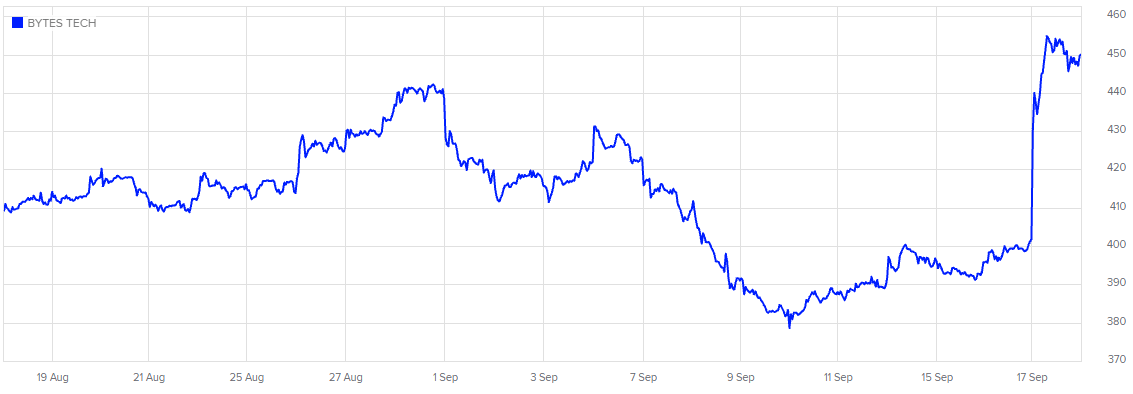
On 17 September, Surrey-based Bytes Technology Group (LON:BYIT) told the market it had traded ahead of expectations in the six months to 31 August and raised its guidance for the full year. For a company that spent much of last year absorbing changes to how Microsoft pays its partners, that is a real shift in tone. The shares agreed, jumping around 12 per cent on the day to 450p.
Two top lines, and why it matters
Bytes is a value-added reseller, or VAR. It sells other companies’ software, security and cloud products, mostly Microsoft’s, and wraps its own consulting and managed services around them. Most of that software is recognised on an agent basis rather than as principal, which changes how you read the top line. When Bytes passes a large Microsoft licence through to a customer, accounting rules mean it books only its own slice as revenue, not the full invoice value. So the group reports two very different numbers. Gross invoiced income, the total billed to customers, came to £2.34bn last year. Reported revenue under those rules was just £220.5m. Neither is the one to anchor on. The best gauge of the underlying business is gross profit, roughly the margin the group keeps after paying its suppliers, which came in at £167.3m last year.
What the update actually said
That distinction is the whole point of this update. Gross invoiced income rose around 19 per cent year-on-year in the half, but gross profit, the number that matters, rose around 18 per cent. Operating profit, what is left after running costs, rose around 6 per cent.
The context makes the acceleration clearer. In the year to February 2026, gross profit grew just 2.5 per cent and operating profit fell 5.6 per cent, as Microsoft reworked its partner incentives and Bytes reorganised its private-sector sales teams at the same time. Growth firmed up as that year went on, with gross profit up around 6 per cent in the final two months. A run rate near 18 per cent in the first half of FY27 is a clear step up.
The upgrade
When it posted those full-year results in May, Bytes guided cautiously: high single-digit to low double-digit gross profit growth for FY27, and operating profit broadly flat while it absorbed about £4.5m of higher technology and staff costs. It has now lifted both. The board expects gross profit growth in the low-to-mid teens for the full year, with low-to-mid single-digit operating profit growth.
The gap between those two lines is deliberate rather than a warning. Operating profit is growing more slowly than gross profit because Bytes is carrying the cost normalisation it flagged in the spring: higher spending on its technology platforms after a run of strategic projects, and bonuses returning to normal after a leaner year. Those costs sit across the whole year, which is why full-year operating profit growth is guided well below the gross profit line even after the upgrade.
The AI question
Chief executive Sam Mudd leaned on artificial intelligence in her commentary, calling it a more meaningful driver of growth in the core business. That deserves some care. For a reseller, AI demand tends to arrive as extra Microsoft Copilot licences, plus the security and cloud work needed to support them and the services to get customers running. It is real, and it is showing up in the figures, but it flows through the same Microsoft-heavy model that caused the trouble last year, which means the AI upside is bound up with the same vendor reliance. The 13 October results should show how much of the upgrade is genuinely AI-led rather than a broader recovery in software spending.
Cash and the balance sheet
Net cash fell over the half, from around £99m at the February year-end to around £68m at the end of August. That is not deterioration so much as timing and generosity: the group paid out £41.3m to shareholders through its FY26 final dividend and share buybacks, and it collects most of its cash in the second half anyway. That seasonality is why cash conversion, the share of profit that turns into actual cash, was only around 45 per cent in the half, up from 34 per cent a year earlier but well short of the 105 per cent booked across the whole of last year. The underlying position is still strong: no debt, and a model that ties up little capital, which is what funds the payouts in the first place.
Structure and people to watch
Two structural points are worth keeping in view. Bytes is splitting its go-to-market by sector, with the Bytes brand serving private-sector customers and its Phoenix Software arm the public sector, which still accounts for around two-thirds of billings. And the leadership has been reshaped over the past year: managing director Jack Watson left in March with no direct replacement, and the combined finance and operations role is being split, with chief financial officer Andrew Holden moving to chief operating officer once a new CFO is found. Neither is alarming by itself, but a business this reliant on a handful of vendor relationships and on public-sector budgets is one to watch on execution.
What 13 October needs to show
This was an estimate ahead of the half-year results on 13 October. Those will confirm whether gross profit really is running in the high teens, how the growth splits between private and public sector, and whether there are hard figures behind the AI story yet. On this update, the recovery that started in the back half of last year has carried into this one with room to spare.
Ollz.