

Dear reader,
August was the month the panic didn’t arrive. July had ended with the AI trade in something close to a rout, chip stocks falling in double digits, a hedge fund being bailed out, and the money leaving all of it looking for somewhere calmer to sit. The obvious fear was that July was the first crack and August would be the break. It wasn’t. Late in the month Nvidia reported, the numbers were strong, the big cloud buyers stuck to their spending plans, and the semiconductor names bounced hard the next day. The rotation out of expensive tech and into value and income, the wave that carried this portfolio through June and July, did not reverse. It simply lost its urgency. When the thing you are fleeing stops falling, you stop fleeing it quite so fast.
That is most of the story of the month for a portfolio like this one. After two strong months in a row, August was a pause rather than a third leg up. The capital sat roughly still, a shade lower on paper by month end, while the holdings quietly got on with the job they are actually here to do, which was paying us. And they paid us a lot, because August is one of the year’s heavy dividend months. More on exactly which names below.
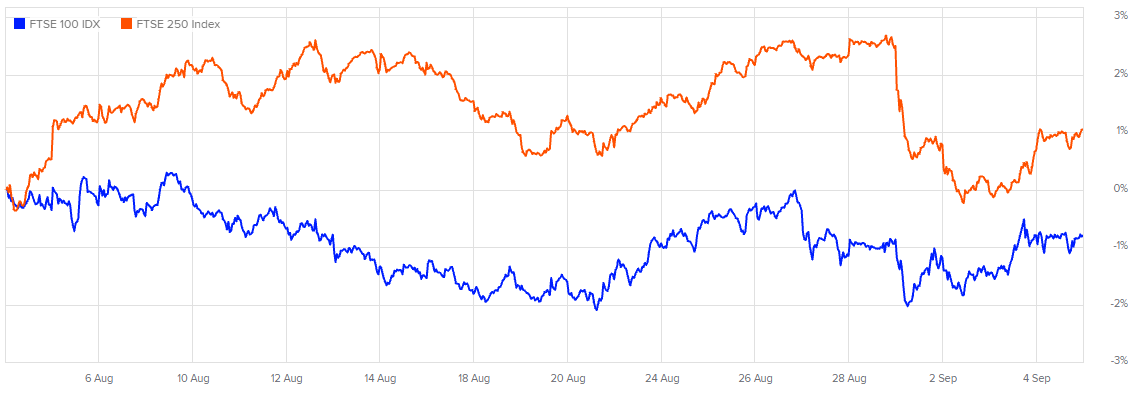
Closer to home, the interesting shift was underneath the headline index. For most of this year the story has been the globally-earning FTSE 100 setting records while the domestic FTSE 250 was left behind. In August that flipped. The mid-cap 250 hit fresh record highs of its own early in the month and spent August as the stronger of the two, up more than 10% for the year, carried by the takeover wave still sweeping London, by selective buying from the big institutions, and by its heavy weighting in aerospace and engineering. For a portfolio stuffed with unloved, cash-generative mid-caps, the 250 finally being noticed is exactly the kind of turn we have been waiting on.
“The often overlooked and perhaps underappreciated FTSE 250.”
— Richard Hunter, interactive investor
The FTSE 100, for its part, held near record territory just shy of its July peak, its six-session winning streak breaking late in the month as a softer oil price weighed on the big energy names and the miners did the offsetting.
For an income portfolio, though, one number still matters more than any index level, and in August it moved the wrong way. Inflation, released on 19 August, rose to 2.9% in the year to July, up from 2.6% and the first increase since March. The cause was almost entirely energy. The regulator’s price cap rose 13% from July, adding a little over £200 to the typical annual household bill, and gas prices alone jumped nearly 15% in the month, the biggest rise since 2022. Strip out food and energy and the picture is calmer, with core inflation steady at 2.6% and services inflation actually easing to 3.4%. So the underlying pressure is contained. But the headline is now drifting up towards the roughly 3.2% peak the Bank flagged for the fourth quarter, and it is doing so exactly as three of the Bank’s nine rate-setters have started voting to hike rather than cut.
The Bank does not meet again until 17 September. A hotter inflation print, an energy shock still feeding through, and a committee with a growing hawkish minority together make a rate cut that day close to unthinkable. Another hold is the honest base case, and the risk around it points up, not down. That is not the outcome the rate-sensitive parts of this portfolio, the renewables, the infrastructure trusts, the REITs, would choose. They would rather see cuts. But they will keep earning without them, the discounts on their assets stay wide, and the income keeps landing regardless. This is a portfolio built to be paid while it waits.
August research highlights
Alongside the portfolio update, August was another busy month for research on Corfe Capital. Here’s everything published this month, well worth a read if any slipped past you:
🏥 Primary Health Properties (LON: PHP): Income up 109%, debt at 57% of the portfolio, and a dividend caught between them. — 6 August
🌏 Henderson Far East Income (LON: HFEL): Eighteen years of rising dividends, a near-10% yield, and a discount that has quietly turned into a premium. — 19 August
🏗️ Vistry Group (LON: VTY): A £350m Homes England grant revives partner demand, but the beaten-down housebuilder still has to prove it can turn it into profit. — 25 August
Sector Commentary

Property & Healthcare REITs (22% of portfolio) remains the largest sleeve in the portfolio, just, and it is still where the clearest structural story sits. Healthcare property is the stronger of the two legs, with big institutional buyers chasing the long, inflation-linked leases and the ageing-population demographics behind them. The office side is the quieter surprise, with return-to-office mandates pushing occupiers back towards the best buildings and supporting the large-cap London landlords. With the base rate stuck at 3.75%, it is the rent doing the work here while asset values recover slowly, and a recovering property market is precisely one that keeps paying its dividends on schedule while the share prices catch up.
Infrastructure & Credit (22% of portfolio) is the backbone of the portfolio and level-pegging with property as the largest allocation. The story here has not really changed. The listed infrastructure trusts still trade at wide discounts to the value of the assets they own, a hangover from higher-for-longer rates that has been slow to clear. What closes that gap is corporate action, buybacks, asset sales at or above the carrying value, the occasional takeover approach, rather than a change of heart from the Bank of England. The income itself is contracted and rises with inflation. The re-rating can wait on sentiment. The income does not.
Other / Diversified (16% of portfolio) is the widest spread of names in the portfolio, and the bigger backdrop above the stock level is the takeover wave still running through UK plc, with overseas and private-equity buyers turning up all year to pay large premiums for companies they think are far too cheap. Within the portfolio the picture was mixed as ever. The specialist engineer that has been the standout of the whole book stayed strong, the recovering discount retailer marked time after a big run, and the long-standing commodity laggard carried on being the one position that will not cooperate.
Renewable Energy (13% of portfolio) is the most rate-sensitive corner of the portfolio and the one most geared to any eventual shift from the Bank, which makes an August of firmer inflation and no cut in prospect a patient month rather than a rewarding one. The wide discounts dogging the renewable-infrastructure trusts are the same higher-for-longer story as their infrastructure cousins. One overhang has at least gone for good, with the government confirming it will keep a single national power price rather than move to regional pricing, which takes a lump of policy uncertainty off the table. Asset sales in the sector keep going through at or above book value, which tells you the holdings are worth more than the share prices say. If rates begin to turn in 2027, there is real re-rating to come.
Technology (13% of portfolio) had the most eventful backdrop of any portfolio, though not because of anything it owns. The global AI trade spent July in a genuine sell-off and then steadied sharply in August after a strong set of results from the largest chipmaker and confirmation that the big cloud buyers are still spending. That is a market arguing about the value of expensive American hardware. The technology here is a different animal, UK-listed, sensibly valued, the sort of quality mid-cap that tends to benefit when the hype drains out of the sector and buyers go looking for reasonable prices again.
Investment Trusts, Global & Regional Income (10% of portfolio) ticked along after a strong recent run. The wider trust sector is quietly healing, with the average UK investment trust discount now under 10% for the first time since 2022, helped by record levels of buybacks, a run of mergers, and activist investors leaning on boards to close the gap. The high single-digit yields in this sleeve keep landing quarterly whatever the discount does, and the sleeve earns its place giving the book real diversification away from an increasingly two-speed domestic market.
Financial Services (3% of portfolio) is the smallest sleeve and, as usual, the most two-sided. The value rotation is a genuine tailwind for the diversified insurers, and one holding here has been one of the quiet winners of the book all year. The asset managers are the harder half, still fighting outflows and consolidating to cope, and still firmly out of favour with a market that is not yet ready to trust them. This is the sort of sleeve that turns first when sentiment shifts, in either direction.
The rest of this update is for paid subscribers: the full portfolio and every weighting, the named winners and losers, this month’s trades, and the dividend detail.
